
Hello, beautiful humans! I am very excited to share my experience with the process of creating the “Quiet Bloom” game. I hope you enjoy it!
When I first heard that we had to create a game from scratch, I remember being confused and excited at the same time. I thought to myself, ‘How can I create a game with zero knowledge about programming?’ How am I going to make it work?” After jumping to many conclusions all at once, I was at peace knowing that it was going to be a long process of brainstorming, trial and error, drafts, reflecting, and testing. In addition to that, we did not need any prior knowledge about computing at all! In fact, Dr. Maha made it way easier for us to navigate the process very smoothly and professionally. As a very anxious person who suffers from IBS, I found it interesting to make a game about something I suffer from so that I could create a relatable game for all anxious people, myself included. With that being said, I would like to introduce you to “Quiet Bloom” a safe space where you can explore your anxiety and manage it using some techniques while listening to some calming and relaxing music.
The game is basically addressing people with anxiety who find it hard to seek help from others right away so they can just do some techniques that are thought to be effective in each case offered in the game or in each pathway. For example, as soon as you click begin, you get to choose your concern that keeps you heavy-headed at the moment.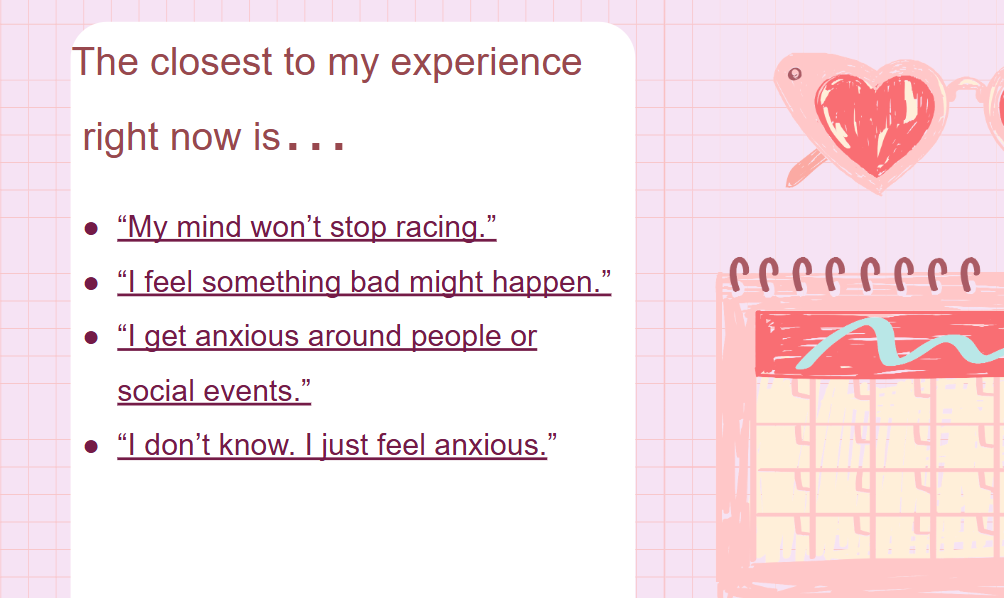
- Each question of these leads you to another question that assesses the exact technique that the player should be using to overcome the negative thoughts they are experiencing.
- Your answer might lead you to a challenge you have to do in order to unlock a badge or a star.
- It also might lead you to another link that you should open in order to do some practice that is thought to help you complete the technique or the challenge.
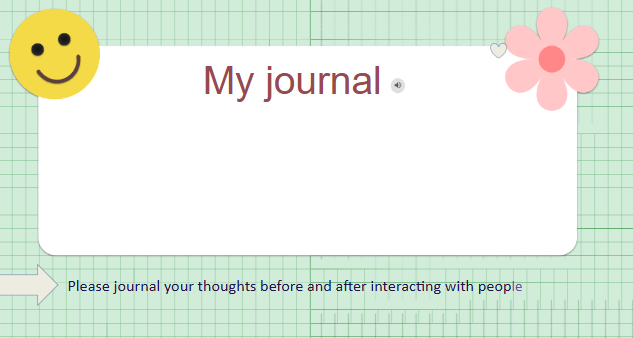
Also, there is a journaling section where players get to journal their fears, negative thoughts, or even any minor inconveniences.
NOTE: I thought it would be better for players to journal while listening to some music, so I inserted a piece of music in this part; however, it is optional because I know some people cannot focus with music on.
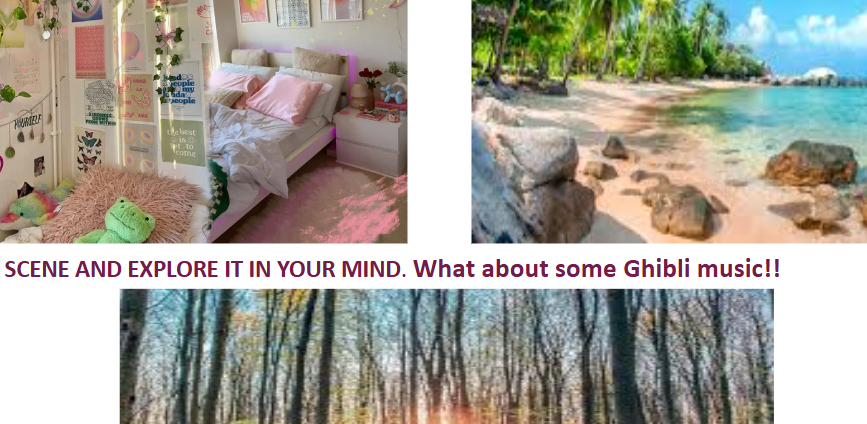 In some pathways, the best thing for the player was to disassociate themselves from their surroundings a little. So, I added some imaginary scenes for them to choose from, along with some music that matches the vibe of the places. (shown in the picture)
Finally, I added a closing slide to all pathways that reflects the importance of validating our own feelings the same way as we validate others’, even in times when they can not name their own feelings. That also goes hand in hand with the name of the game, “quite bloom”, which reflects slow growth, understanding of our own nature, and soul.
In terms of the method I used to create the game, as shown in the pictures above, I used Google Slides. I thought it was the best way to display the game instead of using Google Forms or any random website. It is also pretty common, so almost everyone can use it without facing any complex problems. In addition to that, I used some AI tools, mostly GPT, to help me improve the pathways and make the game more valuable and helpful for others. Despite thinking of other tools to use, I found myself ending up with GPT after offering exactly what I wanted and applying every note perfectly, unlike other tools.
In the first draft, there were some problems, such as broken links, improper sequencing, and missing slides. Despite the fact that, I was certain of the value of the pathways and the content, these issues made it hard for my colleagues to navigate the game properly as well as view the game the same way as I did. With that being said, I was determined to make the experience of playing the game smoother and more effective in the final draft.
If I had to change something in the game, I would add more pathways, questions, and challenges to make the game relatable on so many levels for others. I would also add some creative tools for each pathway and make sure they are applicable while staying in their personal space.
Creating this game has been more than just a project. It’s been a personal journey. Along the way, I realized how often we try to explain or fix our anxiety when, in fact, what we need most is a space to feel it without pressure. I wanted to build something soft that doesn’t ask too much. Just a quiet place to land when everything feels heavy or unclear. Matter of fact, designing this game taught me to listen more deeply, not just to others but to myself. It reminded me that even small moments like a single breath, a kind word, or a floating thought can make a big difference. And maybe, in creating something to comfort others, I was also learning how to comfort myself!
At the end, the game is a reminder that peace isn’t found by pushing anxiety away but by gently turning toward it with compassion, presence, and patience. The game encourages players to slow down, listen inward, and remember that they’re never alone in what they feel.


Provide Feedback