The Weight of Truth: A Moral Dilemma Game
Welcome to my game!!
This game is attached to a value that is very dear to me: honesty. Have fun reading my reflection and most importantly playing my game:
Life is full of moments where we must choose between speaking difficult truths or telling comforting lies. These decisions shape who we are and how others see us. That simple but powerful idea lies at the heart of The Weight of Truth, an interactive moral dilemma game that invites players to navigate 10 everyday scenarios where honesty, deception, and compromise are all on the table. Rather than offering clear-cut right or wrong answers, the game challenges players to reflect on the consequences of their decisions, not just in the moment, but in how those choices define their relationships, self-respect, and personal values. Through a series of connected, thought-provoking situations, The Weight of Truth explores what it really means to live with integrity in a world full of gray areas.
The evolution of The Weight of Truth from its initial concept to final form represents a fascinating journey of iterative design driven by comments from my classmates and professor. Originally conceived as The Burden of Truth, a political decision-making simulator where players navigated ethical challenges as national leaders, the game underwent a fundamental transformation after the professor suggested that personal dilemmas would create stronger emotional engagement, as it would be perfect for my expertise as a normal citizen not a political leader. This pivotal insight led me to completely rework the narrative framework, replacing high-stakes political scenarios with intimate, relatable situations like workplace honesty, friendship tests, and family obligations that happen every day. While the core mechanics remained similar, this shift from macro to micro ethics made the experience more universally accessible while maintaining depth of moral exploration.
The original interface’s prominent “Truth” and “Power” meters, while providing immediate feedback, were found to distract from narrative flow and encourage score optimization over authentic choices by making choices seem as right and wrong. Removing these from main gameplay while preserving them in final results created a cleaner, more immersive experience by giving a score at the end of the game. Similarly, the early version’s color-coded choices (green for truth, yellow for middle ground, red for lies) created unconscious bias, leading me to implement neutral, identical buttons that encouraged deeper engagement with each dilemma’s substance. Structural changes included establishing fixed 10 scenario playthroughs with randomized ordering instead of variable-length branching paths, ensuring consistent yet varied experiences with every path leading to a total of 10 scenarios. The addition of an explicit “Continue” button after the comment of each choice proved surprisingly impactful by giving players needed reflection time between choices.
The technical development journey began with rapid prototyping on Poe to test core mechanics before transitioning to DeepSeek for more robust implementation of the game with the modifications I just discussed. This progression taught me valuable lessons about I can do a game that does not have biases and has authentic choices. Most importantly, I learned how personal dilemmas create deeper player connections than political ones as it is my expertise, and how pacing controls like “continue” can significantly impact the quality of engagement.
Looking ahead, there are many exciting ways to improve the game. With more time, I would add a system to randomly create new scenarios that still follow a clear and connected story. I also want each choice to shape what happens next, so that every branch feels like its own complete story. A feature for players to create and share their own dilemmas would make the game more interactive. And by adding profiles, players could see how their decision-making changes over different playthroughs. However, I was not able to add all these features because of the time constraint. These potential improvements would enhance the game’s existing strengths while opening up new possibilities for interactive moral storytelling, ultimately creating a deeper, more personalized, and engaging player experience.
The Weight of Truth stands as a testament to the power of moral games and how they can teach us valuable lessons. What began as an abstract political simulation has transformed into a intimate moral mirror that challenges players to confront ethical complexities in everyday life. Ultimately, the game’s greatest success may be in how it reveals the most interesting truths aren’t about hypothetical scenarios, but about ourselves and the choices we make when no one is watching: except, of course, our own conscience.
Play Now!!
First Draft Game Link: https://poe.com/The_Burden_of_Truth
Final Draft Game Link: https://68075ba0bacfab6b6034f98b–nimble-gumdrop-696376.netlify.app/
Sources:
Poe (First Draft): https://poe.com/s/eTSAnLcffJWabFbgCCXC
Deepseek (Final Draft): Since Deepseek doesn’t provide a sharing link, I’m including my input here. The code I received from Poe, combined with this input, produced the complete final code.
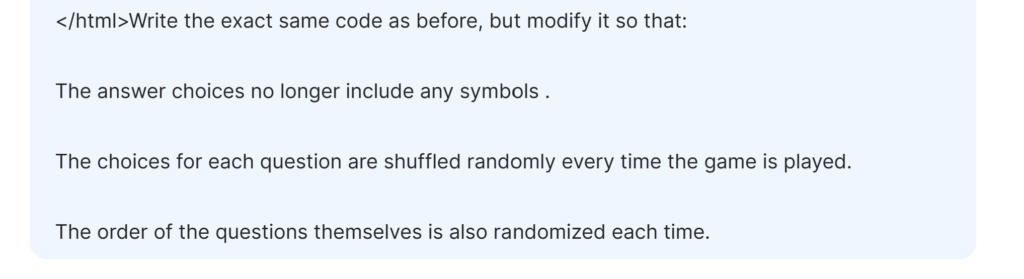
ChatGPT (Idea Generation): https://chatgpt.com/share/67ce8fc2-ee64-800a-b89a-5af57ef3844f


Provide Feedback