
Part I
1. Spent: https://playspent.org/html/
I think poverty decisions work very differently when someone is actually placed in front of them rather than just thinking about them. I felt very curious playing the game, and the game’s interface at first even made me feel like it could be a horror game because of how serious it looked. In the first try, I chose the office job because I felt it would pay more, and my goal was to finish with the most money left. However, I got fired after my manager heard me talking about a protest or union, which showed me how easily someone can lose stability even when trying to do things right. I kept trying to maintain my money as high as possible and ended the month with only $92 saved, but that was without properly buying food and by having someone live with us to help pay bills, which felt stressful. In the second trial, I wanted to see if I could earn more money by working as a server because of tips, and I also ignored some bills and prevented my child from playing sports, which was frustrating because it felt unfair but necessary. Near the end, my landlord raised the rent and I paid it without checking my balance, which caused me to lose all my money on day 30. I liked the game very much because it made me think about many things I usually do not consider and showed how small decisions can have big consequences, although I think improving the user interface would make the experience more engaging.
2. Syrian Journey: Choose your own escape route https://www.bbc.com/news/world-middle-east-32057601
I really empathize with people having to leave their homes because of the struggles they face there. In the first trial, I couldn’t bear leaving a mother and her child struggling because I would not have wanted that for my own family, but that decision eventually led me to end up in a refugee camp without my family. In the second trial, I chose different decisions, which unfortunately led to drowning, and this made me realize how dangerous and uncertain the journey can be for people trying to build a better life for their families. The game made me think deeply about the risks refugees take and the difficult choices they must make under pressure, and it helped me understand that there is often no clearly right decision. I liked how the game allowed me to experience different outcomes depending on my choices and how it created emotional engagement with the story, although something that could be improved is the interface, as well as giving the game its own dedicated website instead of placing it within the BBC news website and getting rid of the blocks of text.
3. Voter Suppression Trial via New York Times : https://www.nytimes.com/interactive/2016/11/01/opinion/voting-suppression-videogame.html
Having no prior information about the voting system in the USA, I decided to play this game to understand it better. At first, I did not find anything particularly useful because I simply chose an avatar, a white programmer from California, and cast my vote without facing any difficulty. I then decided to play again using a different avatar, a Black salesman from Wisconsin, to see if the experience would change. During the second playthrough, I realized that the game was actually demonstrating how difficult voting can be in America for people of different racial backgrounds, as my second avatar had to wait around 70 minutes to vote and even risked being fired from his job, while the white avatar experienced no waiting time at all. This made me understand how race can affect participation in voting and how experiences can differ greatly depending on identity. Something that could be improved in this game is encouraging players more clearly to try multiple avatars so they can fully understand the intended message.
4. Responsible Partying https://docs.google.com/presentation/d/1FUGGJrxTjq9YnmcRGJKG_CsX1npnBy9LpSrlYVAgiNE/mobilepresent?pli=1&slide=id.g72e110cc1_0_0
The game really sheds light on the importance of consent and how it applies to many aspects of life. While playing, I felt reflective because the scenarios made me reconsider how people sometimes misunderstand consent in everyday situations. Something I really liked was the cup of tea analogy, as it explained the concept in a simple and memorable way. The game emphasized that consent is ongoing and cannot be treated as a one-time agreement, which made the message very clear and impactful. It also showed how bad choices can lead to regrettable or even fatal consequences, which made me realize how important awareness and responsibility are in decision-making. The experience encouraged players to think more carefully about their actions and respect boundaries, although the game could be improved by adding more interactive choices and less blocky text so players feel more personally involved in the outcomes.
5. Orphans and Society https://docs.google.com/presentation/d/1To5rlSOTbt9-oqV9dBAEYJ76NvT–YpEFiK9dzzdmi4/edit?slide=id.g124c4e5f806_0_1030#slide=id.g124c4e5f806_0_1030
I really enjoyed the game because it exposed me to a side of an issue that few people are aware of. The first thing that caught my attention was the slide asking players to Google “يتيم” which made me reflect on images I had previously seen and assumed were normal. I realized that some of these images may have been taken without the consent of the children involved, which changed my perspective significantly. As the scenarios progressed, I became more aware of the situations people go through and how to respond more responsibly if faced with similar circumstances. The game helped increase my awareness and encouraged me to think more critically about ethical responsibility, although I believe it could be improved by enhancing the interface and adding more scenarios to deepen the experience.
6. Among Us for teaching English https://docs.google.com/presentation/d/1LIAkSEJW6hrU_GOsIZujJc8RI5VSeFoER_ad4WU55jI/view?slide=id.p#slide=id.p
The title immediately stood out to me because I really enjoyed playing Among Us a few years ago, which made me interested in trying the game. The game was very interactive, and I especially liked the hints feature because it helped guide me through the questions without making the experience frustrating. Playing it also brought back many memories of when I used to play Among Us, which made the experience more engaging and enjoyable. I was able to reach the end without repeating any questions since I answered them correctly, which gave me a sense of accomplishment. Overall, the game was enjoyable and educational, although it could be improved by adding more questions and increasing the difficulty level.
7. Cloud 4
I really enjoyed playing the games we had in class, but what stood out to me the most was Cloud 4. The game allowed me to talk about myself and express different emotions in front of three classmates I had never spoken to before, which was a unique experience since I rarely share my emotions with others. I especially liked how the game encouraged openness and communication in a comfortable environment. Another aspect I enjoyed was being exposed to new words used to describe emotions, which was valuable for me as an engineering major who usually deals with numbers and does not often spend time expanding emotional vocabulary through reading. Overall, the experience felt meaningful and although I do not have major suggestions for improvement, I think creating a digital version of the game could make it more accessible and engaging for more people.
Comparison:
Playing all these games made me realize that each one teaches something in a very different way even though they all try to build awareness and empathy. Games like Spent and Syrian Journey affected me the most emotionally because I felt pressure while making decisions that could completely change the outcome, whether it was losing money or risking safety, and both showed me how difficult real-life choices can be when there is no perfect option. The Voter Suppression game was different because I only understood its message after playing with another avatar and seeing how identity changes experience, which made me realize how perspective matters. Responsible Partying and Orphans and Society focused more on awareness and responsibility, making me reflect on consent and ethical behavior in situations I normally would not think deeply about. The Among Us game felt lighter and more educational since it focused on interaction and learning rather than emotional pressure. Cloud 4 stood out because it involved real conversations with classmates, which made expressing emotions feel more real than interacting with a screen. I noticed that some games teach through stress and difficult decisions, others through awareness and discussion, and others through interaction, but all of them helped me understand different perspectives and think about topics I usually do not consider in daily life.
Part II
Ikigai:
- What do you love?
– My family, relaxing, learning new things, and challenging myself - What are you good at?
– Numbers, engineering, listening, and expecting things to happen - What can you be paid for? Or What can you get credit for in your course?
– Video editing, teaching, playing video games, telling my past experiences, engineering tasks - What does the world need?
– Emotional intelligence, communication, less stress, money
VIA Survey:
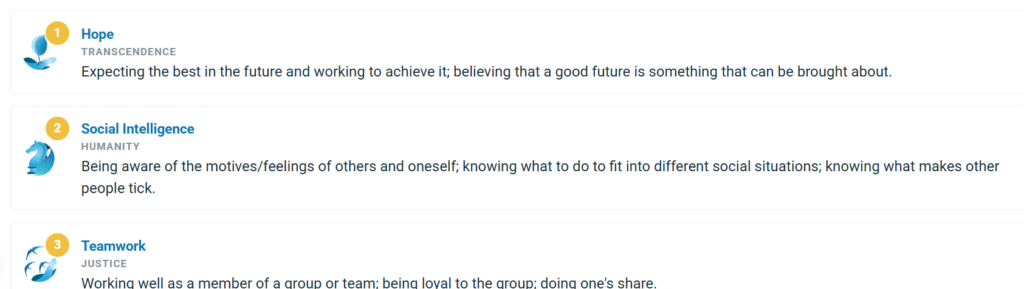
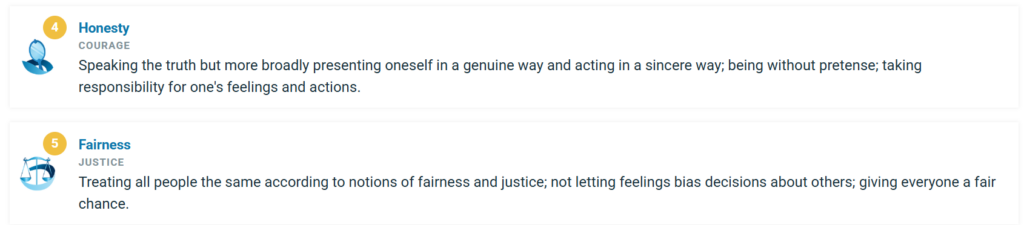
Link to my chat: https://chatgpt.com/share/69a302c0-88c4-8003-b659-88757aa53b3b
After giving ChatGPT my VIA and Ikigai results, it suggested several ideas for my narrative game, but the one that stood out the most was a game called The Last Normal Week. The idea focuses on a student trying to balance life expectations with personal well-being while going through a stressful university or work week, where daily decisions affect stress levels, relationships, success, and mental health. When I asked why this idea was recommended, the AI explained that it sits at the center of my Ikigai and connects strongly with my character strengths such as hope, social intelligence, honesty, and fairness, while also matching my engineering mindset and reflecting real experiences from my life. Reading these reasons made me feel that the idea truly represented me and my experiences, and I felt a strong connection to the concept. This recommendation resonated with me the most, and I am interested in exploring and developing it further as my narrative game idea.


Provide Feedback