1. Spent
How I felt:
I played Spent as a struggling father trying to survive day by day with my son on a limited income. It was deeply depressing to feel trapped by money, especially when I knew my son was talented but I couldn’t help him thrive. I questioned whether poverty is the fault of individuals or a failure of the system itself.
What I learned:
I realized that what I considered a “loss” in the game is someone’s real life, families forced to choose between rent, food, and education. It taught me empathy and reminded me how fragile financial stability can be.
Critique / Suggestion:
The game throws players in too suddenly without explaining much, and there are too many clickable areas that don’t matter. The ending could be more emotionally conclusive instead of cutting off with a donation screen.
2. Syrian Journey: Choose Your Own Escape Route (BBC)
How I felt:
Playing as a Syrian refugee escaping war was heartbreaking. I imagined being in a foreign land like Egypt, unsure if my family would survive. I kept thinking: Why me? Why my family? Every decision carried fear and guilt.
What I learned:
It made me profoundly grateful for the safety and privilege I have. I learned how displacement strips people of control, forcing them to make impossible moral choices.
Critique / Suggestion:
The choices were too limited, it could use more branching paths to deepen emotional engagement and realism.
3.September 7th, 2020
How I felt:
The game follows a trans student in a wheelchair during the pandemic. I tried to empathize, but the tone felt exaggerated and overly dramatic. It didn’t connect emotionally for me; I found the situations unrealistic and forced.
What I learned:
It reminded me that not every story of hardship resonates with every audience, representation must still feel authentic and balanced.
Critique / Suggestion:
The narration and choices could be rewritten with more depth and realism. The ending lacked any real takeaway, making the experience feel incomplete.
4.October 1st, 2020
How I felt:
Made by the same author as the previous game, this one focused on a partner’s cancer during the COVID pandemic. It was relentlessly bleak, filled with constant bad news that made it hard to stay engaged.
What I learned:
I realized that emotional realism in games doesn’t mean overwhelming players with sadness. Even in crisis, people find small joys, and that balance is missing here.
Critique / Suggestion:
Add more moments of light or hope to contrast with the pain. The storytelling should reflect emotional range, not just despair.
5. Trócaire Game: Climate Change in Honduras
How I felt:
I liked the clean interface and the sense that my decisions mattered, but by the end, it felt repetitive and anticlimactic. I wanted a story arc that showed the long-term effects of my actions.
What I learned:
The game taught me how climate issues can feel invisible, even when you’re “doing the right thing,” change takes time.
Critique / Suggestion:
Include stronger narration or characters to make the connection between individual decisions and their global impact clearer.
6.Opinion | ‘The Voter Suppression Trail’ – The New York Times
How I felt:
The pixel-art design reminded me of Minecraft, which made it fun at first. I liked choosing between three different characters and appreciated that the game didn’t focus on race, even when I played as a Black salesperson. Still, it felt a bit forced politically and ended abruptly when I couldn’t vote because I forgot my ID.
What I learned:
Voting is often about navigating hard moments as much as civic duty. Humor can make a serious topic more approachable, but it can also undercut the impact.
Critique / Suggestion:
Tone down the political jokes and expand cultural accessibility so non-Americans can relate to the process of voting.
7. Empathy Toy (Blindfolded Wooden Shape Game played in class)
How I felt:
This in-class game was surprisingly powerful. Being blindfolded while trying to instruct someone else, also blindfolded, to replicate a wooden shape was both funny and stressful. It made me realize how much we rely on sight for communication.
What I learned:
It helped me appreciate the challenges faced by visually impaired people and how much patience and clear language matter. Watching a visually impaired classmate play showed that adaptation can transform limitation into strength.
Critique / Suggestion:
No real flaws, perhaps make it more structured so teams can debrief after playing to discuss what worked or didn’t in their communication.
8. Domestic Violence in Egypt (Student-Created Game, 2017)
How I felt:
This game made me feel a strange mix of anger and helplessness. When I went to the police station in the game and they told me to “go back and not bring shame to your husband,” I was furious. If the police, the husband’s family, and even the culture refuse to support women, how is change ever supposed to happen? The game made me question our society, we call ourselves a culture rooted in Islam, yet we ignore its teachings on justice and compassion.
What I learned:
It reminded me how cultural norms can perpetuate injustice even when religion and ethics oppose it. I realized that silence and shame are powerful tools used to maintain oppression, and that empathy is useless unless it leads to accountability.
Critique / Suggestion:
The story was emotionally strong, but it seemed based on limited perspectives, mainly one or two cases of abuse, and relied on foreign rather than Egyptian research. More local data or interviews could make the narrative feel more authentic and relevant.
9. Street-Sweeper (Student-Created Game, 2017)
How I felt:
I liked the idea behind the game, showing the life of a street sweeper, but the execution felt shallow. The story lacked emotional depth; it was more about choosing the “right” option to get paid rather than exploring the humanity or struggles of the worker. Because of this, I didn’t feel much empathy or connection to the character.
What I learned:
I realized how easily a serious topic can lose its emotional impact if the storytelling isn’t developed enough. The concept had strong potential, but it needed more detail and human perspective to make the player care.
Critique / Suggestion:
The game should go beyond simple win/lose mechanics and instead include multiple storylines that reveal the worker’s emotions, background, and challenges. That would make it more immersive and meaningful.
Comparative Reflection
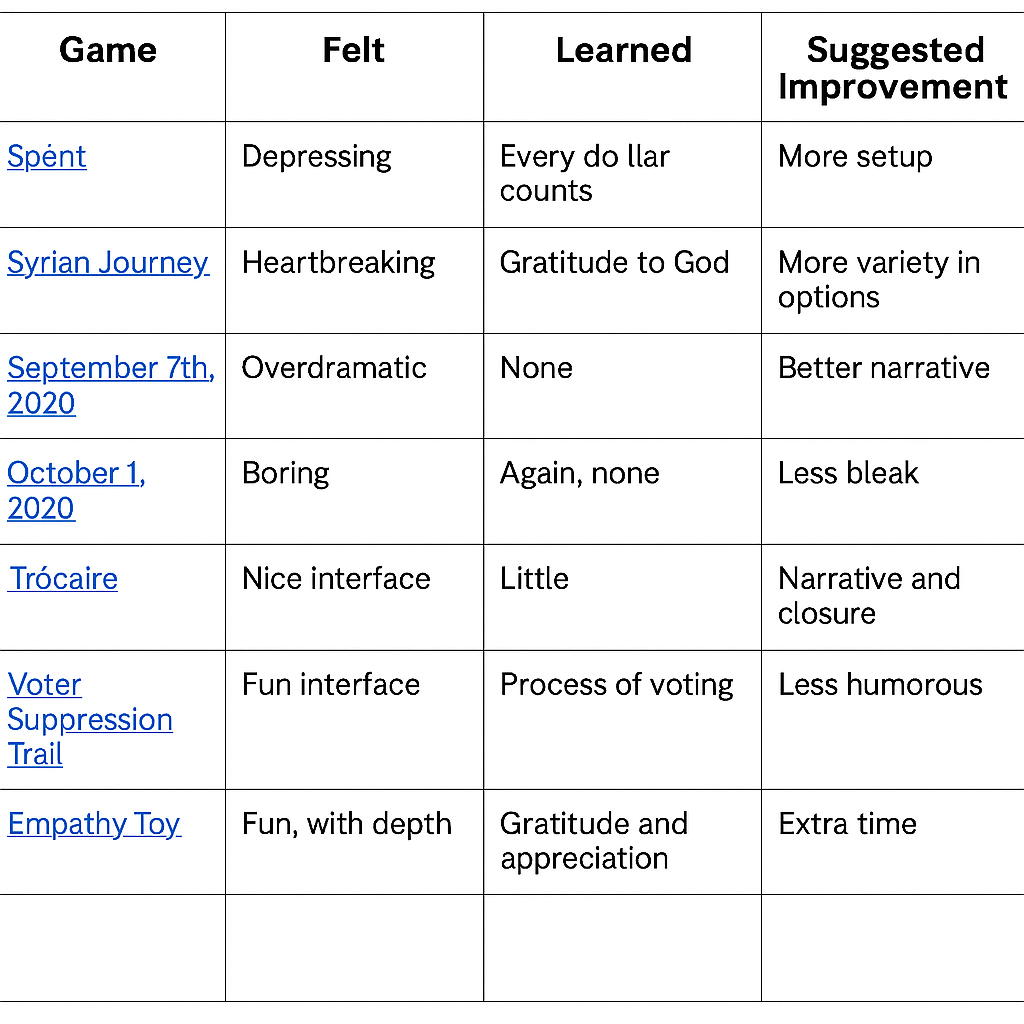
Across all nine games, I noticed that digital narrative games rely heavily on choice and story, while physical games like the Empathy Toy depend on sensation and communication. Spent and Syrian Journey created genuine empathy by immersing me in painful but real scenarios, while September 7th, 2020 and October 1st, 2020 failed to connect emotionally because their tone felt performative rather than authentic. The Trócaire and Voter Suppression games taught valuable lessons through design but lacked emotional closure, leaving me unsatisfied by their endings. In contrast, the two student-created games, Domestic Violence in Egypt and Street Sweeper, offered local cultural insight but in very different ways. Domestic Violence in Egypt was deeply unsettling yet powerful, exposing the hypocrisy and silence around gender-based abuse in Egyptian society, while Street Sweeper had potential but lacked emotional depth and realism, making it difficult to feel connected to its message. Among them all, the Empathy Toy stood out the most, transforming a simple act of giving instructions into a profound awareness exercise about privilege, perception, and disability. If I were to create my own narrative game, it would explore moral dilemmas, where choices emotional burnout, and systemic pressures reveal what empathy truly means under stress.
I used ChatGPT. Here is the prompt I used https://chatgpt.com/share/68ec1d4d-8aa4-800c-bbe2-69873fb82524


Provide Feedback