This course is a unique course that I’m glad I decided to take, as its approach to education was very different then im used to. Positively, this course made me as a student feel like I truly wanted to learn and attend the next class, as it not only taught me about the perspectives of others but also taught me more about myself. It pushed me to reflect on my identity, values, and we even made me reflect on my use of technology alongside other factors that i never fully considered before, such as Terms and Service which in each application i never bothered to even consider where my information could be going, or learning about various use of AI such as each being designed in certain ways to fulfil certain tasks, and having to be cautious and skeptical of what i prompt it as it is not always 100% accurate and should not be relied on to much, it should be a tool that assist me not replaces my thinking. This course also helped me with communication skills. I believe it even helped me become a kinder person. I now pay attention whenever I’m with friends or new individuals to try to make them feel included. If I notice that they feel like they don’t belong, I try to add them to the conversation in any way, which was something I never paid attention to before this course. This course connected creativity, games, AI, intercultural learning, ethics, and personal reflection. The most interesting parts for me were anything that was hands-on; the in-class activities were by far my favorite, as I not only learned about myself but also my other classmates. Listening to their discussions after each game was always very interesting, as I would learn a lot from how the others thought. Not only did I learn how to conduct interviews and be able to determine between good and bad interview questions, but I also learned how to lead a conversation to dig deeper to learn more about the individual’s response.
One of the most impactful learning experiences for me was the activities that worked on our identity and had us reflect on ourselves. At the beginning of the course, I remember doing the ALTCV and the video on How language shapes the way we think. The ALTCV helped me think about myself in a way that a normal CV doesn’t. It helped me reflect on my personality, values, experience, and the parts of my life that I enjoy and shape me. and this tied into the video as it ties strongly into the idea that places, people, languages, and even experiences are what shape us. This was personally important to me because in my final game idea it came from the heart as this was really a time of struggle for me, were i was really depressed with life because of how frequently i moved, and I never had any close friends in my life due to constantly moving So it helped me when it came to writing about this game and completing my final game draft.
Another impactful learning experience was the digital narrative games to be specific part 1, my experience before this with games were only for entertainment purposes but after playing serious games like spent and Syrian Refugee games, i understood that games can actually carry a much deeper lesson for us to learn and portray it in the shape of a game, their aim to teach empathy and decision making, while throwing some consequences and sacrifices in the middle. These games had simple choices that carried much deeper meaning and results, although on the surface they seemed simple, but in reality, they were not. These were choices that many individuals go through every day, and some suffer due to it, especially when people are under pressure because of poverty, war, migration, or other difficult situations. The assignment helped me put myself in others’ shoes; although nowhere near the same experience, they felt it gave me a glimpse of what some people go through in their lives. These games helped me reflect on myself and my choices and taught me the value of educational games. It also gave me an idea of how each game could improve based on my experience with the many games we tried, which tied into helping create my own game at the end of the semester. It helped me understand that a good educational game needs more than a story; it needs meaningful choices, emotional impact, and consequences that make the player think.
The in-class game brainstorming activity was especially important because it helped me come up with my own final game idea. Through brainstorming and feedback, I realized that I could use my personal experience of moving between schools and environments as the basis for a game. My game became a way to show the difficulty of constantly adapting, leaving people behind, and trying to rebuild a sense of belonging in new places. This was meaningful because it turned something personal into something other people could experience and understand through a narrative game.
The third meaningful learning was the emphasis on AI in the course. The AI in Your Profession assignment was very helpful for me to link AI to my major, MICT. I came to know that AI already exists for automation, data analysis, report generation, email, meeting summary, and decision support. The discussions with Dr. Dina Rateb and Mr. Mostafa Khattab of CIB, however, made me more aware of the potential of AI with a critical perspective. I was surprised by Dr. Dina’s attitude, as she was ready to accept students using AI, provided it aids their learning. Mr. Mostafa’s interview was a lesson on the impact of AI in the real world, particularly in the realm of automation, and how businesses can leverage it to train humans, not replace them. This reminded me that AI is strong, but it’s not capable of replacing creativity, leadership, responsibility, and critical thinking.
The AI Literacy Unlocked module 5 also changed the way I view using AI. I think the biggest thing that I took away from it is the difference between using AI for instructions and a conversation. Once I learned this about using AI, I didn’t use it like I would use a vending machine, where I type one thing and get the perfect answer. Rather, I should challenge it, question it, backpedal on it, clarify it, step it up, and step by step push the conversation in a different direction. This was useful to me to distinguish between communicative AI literacy and cognitive AI literacy. Communicative literacy is related to the way that I ask, respond, and influence the conversation. Cognitive literacy is an understanding of what AI can and can’t do, and when I need to make my own decisions.
The course also helped me to learn some of the skills that I can apply in my academic career. like using AI more responsibly to study, research, and write. I learned not to blindly copy/paste AI generated work without comprehending or editing it. I also got to know how to ask more deeply and ask specific questions to get what I am looking for, ask where it found its information, and what the sources of the information being provided. and use AI as a tool to help me, not substitute my thinking. ResearchRabbit and Gemini Deep Research are among the tools that I now use to help me gather information for my research, but they still have some drawbacks. ResearchRabbit helped with finding credible articles, but it didn’t provide any significant explanation. Sometimes, Gemini Deep Research provided general information that was not relevant, so they are not perfect, but as a tool, they at least help in getting closer to what I need done and shortening the time needed to complete the task.
As part of my social life, I will apply the knowledge of empathy, identity, and intercultural communication. Participating in activities such as Soliya, the Tahrir field trip, the Empathy Toy, and the Lina Mounzer reading enabled me to think more deeply about the differences in how people experience the world. In particular, Lina Mounzer’s article made me realize that translation is not just merely switching words from one language to another. It’s also the transporting of feelings, remembrance, suffering, and truth from one culture to another. This gave me some time to reflect on listening to people’s stories, to try to further understand them.
In my career, especially because I am interested in MICT and product management, I will use what I learned about AI ethics, decision-making, and human responsibility. The Ethical AI Use helped me understand that AI decisions are not only technical decisions. They also involve rights, duties, consequences, equity, and oppression. For example, when we discussed professors using AI to create quizzes, we saw that AI might produce questions that do not match what was actually taught in class. That could unfairly harm students. The solution was not to ban AI completely, but to use it with human judgment, transparency, and revision.
If I could share my learning from this course, I would share three things that I learned:
First, I would show my final digital narrative game:https://reflect.creativitycourse.org/published/temporary-goodbyes-game/. I would choose this because it combines many parts of the course: identity, creativity, storytelling, empathy, game design, and personal reflection. It shows my experience as the son of a diplomat and the emotional difficulty of moving between schools and environments. It also shows that I learned how to turn a personal experience into something interactive that other people can feel and think through.
Second, I would post my AI in Your Profession assignment https://reflect.creativitycourse.org/published/ai-in-my-profession-mict-2/ . I would select this one as it is related to my major and future career. It demonstrates that I’m not blind to the potential of AI, but I’m also not scared of it. Interviewed people, went through their responses and made them relate to a real academic workplace and professional situations and connected AI to them. It also revealed to me that I learnt to think through the hype around AI and consider what areas humans still have a job role to play.
Third, In my alternative CV I would include the link to ALTCV https://reflect.creativitycourse.org/published/my-journey-altcv/ . I would select this as it is an initial point of learning in the course. It demonstrates something about me that is more than grades and work experience. It also relates to the focus of the course on identity, creativity, and self-reflection.
I also have a suggestion for a change to make to the course to make it better. I feel like including a rubric would be useful, so I would be able to complete the assignment exactly as asked of me. It should be at the end of each assignment to ensure students have done the work exactly as required, and it would be very useful.
Second, i believe giving more structured feedback before final submissions is very useful. For instance in the game project, i was especially conflicted on what to talk about so it helped me come up with my idea during the brainstorming session we did in class in which i was able to listen to what others picked and take inspiration.
Third, Although the Tahrir trip really was one of the most enjoyable activities we have done in this course, i believe that giving us questions to ask each other was not the best idea, since especially after conducting Soliya i found that being put in a breakout room with others we do not know forces us to interact and develop a natural conversation in which we try to learn about the people infront of us, during this trip when we dropped the questions and began speaking our minds was when it truly felt amazing and fun.
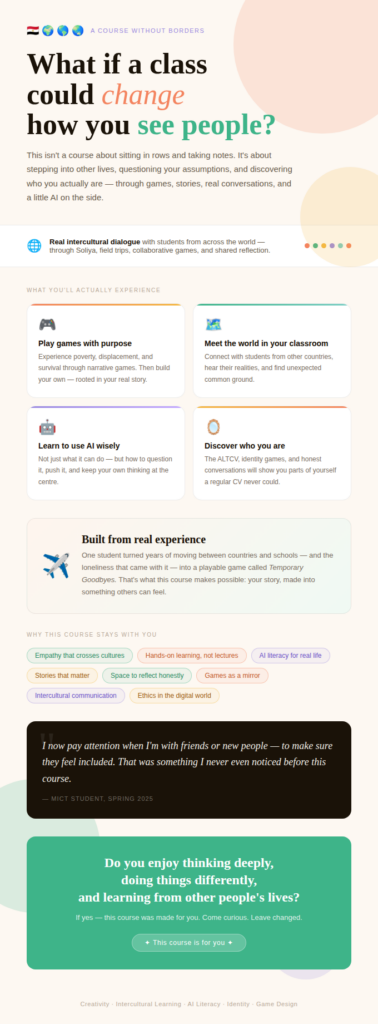
If you can answer “yes” to the following questions, this course is for you: Do you enjoy self-reflection, doing things differently, talking about challenging issues, and learning through hands-on rather than listening to a lecture, taking notes, and studying the day before the exam?
Digital tools that we were introduced to were also heavily featured in the course. I enjoyed one tool: Claude. I liked it because it can be helpful in creating presentations and giving tips on my writing, which can be necessary in research assignments or regular presentations. I wouldn’t use it to write anything for me, but when it comes to providing feedback, it worked quite well for me. Also, I forgot its name, but it was a tool we took near the end of the semester, in which we could search to see how bad the terms of service of a certain platform were. This one is especially important, and i believe everybody should use it. I used to use Gemini for my writing as it had infinite credits and felt efficient but after using Claude, I found myself writing better and receiving better feedback so it helped me improve my writing.
A third tool was Hypothesis, with which we annotated the article that we are reading about Lina Mounzer. I enjoyed it because it helped me with the reading as im a person that has trouble focusing especially in long text. I wasn’t just reading silently, I had to select sentences that were beautiful, truthful or confusing and then respond to them. This made me feel like I wasn’t in a rush and was able to think, i could also see the comments of those before me which were interesting to read and kept me going. I may incorporate this into my studies if I’m reading a lengthy article, as it allows me to retain and be more engrossed with the material.
The fourth was the class blog. I enjoyed that it provided us with a common space where we shared our reflections and assignments. It made the work feel different from just giving it to the professor alone without others. But at times, posting on a blog may not be as formal as submitting a regular assignment. I would certainly use a blog again for creative or reflective tasks but perhaps not for all kinds of academic tasks.
A fifth tool was AI, with a emphasis on ChatGPT. I found the benefit of AI to be that I could brainstorm, organize thoughts and enhance clarity. I was not fond of having to rely on it too much and taking answers on my own. The course has made me understand that the key to leveraging AI is not to have it do my thinking for me, but to use it as a sounding board and a space to test out and modify my ideas.
Cultural experiences with other cultures in the course were also meaningful experiences and the part of the course i enjoyed the most. I was able to communicate across cultures, languages, and different life experiences with the help of Soliya, the Tahrir field trip. It was interesting to me that we met foreign students who were learning advanced Arabic during the Tahrir trip, I thought about language from a different perspective, and culture. Soliya also provided room for intercultural dialogue. These experiences would have been better for me if they had been longer i would have enjoyed it more, i felt like the Tahrir trip was to short of an experience, while Soliya was around the perfect length but i wish we were able to be put in bigger rooms so we could deal with more students instead of the small groups we were placed in.
Overall, I learned that creativity goes beyond creating something artistic in this course. It’s also about thinking, reflecting, using tools, knowing and understanding others, and making meaning out of experiences. I learned about myself, I learned about AI, I learned about empathy, and I learned how learning can take place through games, dialogue, reflection and human connection through the course.
Image attached below is AI generate by claude:


Provide Feedback