1. What were the most impactful learning experiences for me in this course, and what specifically helped me learn them?
About myself
One of the most impactful learning experiences for me in this course was learning to trust my voice and my way of thinking. From the beginning of the semester until the end, this course constantly encouraged me to speak, reflect, create, and share my ideas out loud. This helped me realize that learning is not about having the “perfect” answer, but about engaging, questioning, and growing.
Activities such as Ikigai, VIA strengths, and reflective blog posts helped me understand what motivates me, what my strengths are, and how my values shape the way I think and create. Learning about people like Lina Mounzer also influenced me a lot, because her work showed how creativity, identity, and storytelling are deeply connected. These readings helped me reflect emotionally and personally, not just academically.
Another important lesson I learned about myself is not to give up. This course taught me that grades can improve with time, but more importantly, that learning becomes more meaningful when I enjoy it. Over the semester, I shifted from stressing over grades to focusing on growth, which improved both my mindset and my performance.
That I will use in my academic life
Academically, this course will benefit me a lot because I am a marketing major, and marketing relies heavily on creativity, communication, and confidence. Speaking aloud, sharing ideas, and participating in discussions are essential skills in my field.This course helped me practice expressing my thoughts clearly and creatively. Through discussions, reflections, and creative assignments, I learned how to organize my ideas and communicate them confidently. I now feel more comfortable participating in class, presenting ideas, and thinking creatively instead of memorizing information, and this has already influenced how I approach other courses. Also surprisingly that class tought me that if a person have a disability how I should be able to deal with it and think toward this disability as a challenge not something that I should only sympethize with and that reallly affected my vision toward life and people in it.
That I will use in my social life
Socially, this course helped me become more confident interacting with others. Group work and discussions taught me how to listen actively, respond naturally, and build on other people’s ideas. I became more comfortable starting conversations and expressing myself without overthinking, which helped me both inside and outside the classroom. Also through outings I realizd that the topics i come up with are more precise, clear and not childish or (stupid) I always try to dig deep to reach a meaning behind everything each person says.
That I will use in my career (Marketing)
As a marketing major, the Soliya experience genuinely helped me more than I expected. It was not just discussion-based, but real practice in communication, adaptability, and human connection. Soliya helped me understand how people from different cultures think, speak, and respond. What helped me most was learning how to open conversations naturally, respond on the spot, motivate others, and adjust my tone depending on who I’m speaking to. These are skills that cannot be learned from textbooks and are extremely important in marketing. Soliya made me more confident in communicating with different audiences (cultures) in uni I only used to prefer to interact with Egyptians but now I like to communicate with people from different cultures as I mentioned before that after the 6-7th class that one of my close friends is a Sudanese, and I know this will directly benefit me in my future career as throughout life I will meet people from diffrent cultures especially that I am planning to do my masters in spain.
2. If I were to show someone my learning in this course, which three things would I use and why?
1. My Alt CV
I chose my Alt CV because it represents how I learned to see myself differently. Instead of fitting into a traditional format, this assignment allowed me to express my personality, values, and strengths creatively while still remaining professional. It taught me how personal branding works and how identity can be communicated visually and narratively—something that is extremely relevant to marketing. This artifact shows confidence, self-awareness, and creativity, which are all outcomes of this course.
2. The Narrative Game Project
I chose the narrative game project because it shows real applied learning. This wasn’t just an idea or a reflection—we actually created something from scratch. It represents creativity, teamwork, persistence, and problem-solving. What makes this artifact important to me is that it shows the process behind creativity: starting confused, experimenting, failing, improving, and finally producing something meaningful. It also reflects how I learned to work with others, accept feedback, and use tools like AI creatively rather than passively.
3. Ikigai vs VIA Reflection
I chose this reflection because it shows my internal growth, not just external output. It helped me connect my strengths, passions, values, and purpose together instead of seeing them as separate things. This artifact represents self-discovery and reflection, which were core elements of the course. It pushed me to think about my future in a deeper way—not just what I want to study or work as, but what kind of person I want to be.
3. If I could change 2–3 things about the course to improve it, what would I change and how?
More focus on the Narrative Game
The narrative game project was one of the most valuable parts of the course, but I would have preferred more time and more lectures dedicated to it. I think the project could be broken into clearer stages, with more in-class development time, feedback, and examples. I would also add more structured guidance on how to use AI ethically and creatively when designing narrative games. I also would have liked if we created 2 for diffrent games with causes /awareness toward something and inviting others to come and try the game and people from different generations.
More outdoor sessions
I really wanted more outdoor sessions. I think we only had around two to three, and they were the most enjoyable ones for me. Since the class was at 8:30 in the morning, outdoor activities like short walks, morning discussions, or simple movement-based activities would have been refreshing and energizing. I am a person who likes to move around, and learning outside really matched the creative nature of the course. Also in each 2-minute paper I requested that as I felt that those classes made me come more to my senses and feel the environment around me.
4. In one sentence: What kind of person should take this course?
Someone who is still figuring things out in university and life and wants to grow through creativity, reflection, and interaction with others.
5. Reflection on the tools we learned about in this course (what I liked and what I didn’t)
-
Gemini Deep Search
What I liked: This tool was very useful for finding peer-reviewed articles. I would definitely use it in future research-heavy courses.
What I didn’t like: It can feel overwhelming if you don’t know exactly what you’re looking for, but once used properly, it’s powerful. -
Google Scholar
What I liked: I didn’t realize how useful Google Scholar was until a fact-checking activity we did. We couldn’t find the original source of a news claim anywhere until Youssef found it on Google Scholar. It helped us access reliable sources that are hard to find normally.
What I didn’t like: It’s not always beginner-friendly, but once you know how to use it, it’s very effective. -
Interactive classroom (chairs & boards)
What I liked: The chairs and boards were extremely helpful. Sitting in a circle made interaction easier, and the boards everywhere allowed each group to work freely and move around. This made activities more engaging and collaborative.
What I didn’t like: Honestly, nothing—I wish all classes were designed this way. -
CORE 2096 Reflect (blog platform)
What I liked: Reflect allowed me to save multiple drafts and think deeply before publishing. I saved this reflection more than ten times while revising it.
What I didn’t like: The lack of privacy sometimes made me uncomfortable because everyone could see my work, but I understand that this was intentional and helped us learn from each other.
6. Reflection on the GCC experience and what would have made it better
At the beginning, I thought the GCC experience would be boring, but I ended up enjoying parts of it. Meeting people from different ages and discussing AI was interesting, especially conversations about how teachers versus students use AI. I noticed that many professors are completely against AI, while others are more open to it. This made me reflect on how banning AI is not logical, since it is clearly a major tool for future generations. However, when I compare GCC to Soliya, helped me much more because it was more interactive and directly improved my communication skills. I think GCC could be improved with a shared project to increase interaction.
Point 7
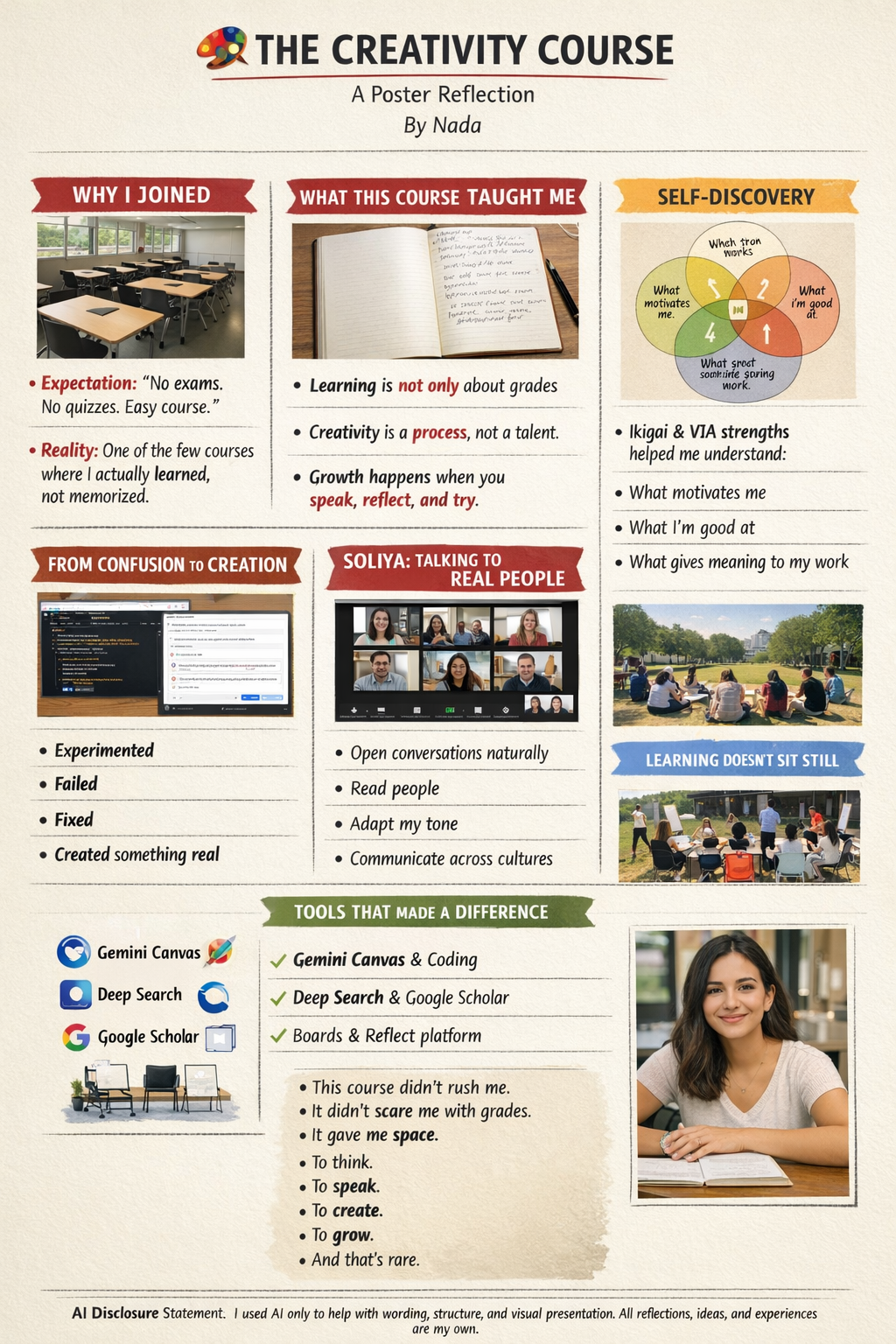
(poster will be in the image since I cant add it here I created a poster with the help of chat hope you like it )
poster ( link for poster )
To be honest I used ai to put together the format and it also helped me in hyperlinking the sources and poster creation
final


Provide Feedback