PART I:
Game 1: Sleep Deprived Mom
https://docs.google.com/forms/d/e/1FAIpQLScap1su2i270VXK3DtWGWA683lyU6UkXJer_cSpN2tl0rXCjQ/viewform?c=0&w=1
I personally felt drawn to playing this game because I have four nephews (two boys from each sister). There were times when my sisters would come and stay with us for months, and I would share a room with them and two of my nephews. Usually, no one got any sleep. They would wake up for so many unnecessary reasons. Specifically, when they were being potty trained, it was a daily struggle. Seeing my sisters show up every day despite being so sleep deprived taught me true resilience and how strength can also show up in care. It made me respect moms more — even my own mom.
This game deeply resonated with me for that reason, and I really enjoyed playing it because I could relate to the scenarios. They were actually realistic and portrayed the life of a mother to some extent. I also really liked the feedback section at the end of the game — it gives a clearer picture of the situation that you might not be able to see when you are in the heart of the experience.
When it comes to improvements, I genuinely feel like the game gets the message across pretty well. The only comment I have is about the visuals. I think if there were pictures, it could help people imagine the state the mom is in and have even more empathy toward her.
Game 2: Depression Quest
Although this game did not take the form of a regular, fun, lighthearted game, I still think it was very insightful. It was very detailed. I really liked how each scenario was described from multiple perspectives. It showed how he felt internally, how that affected his actions, and how it shaped his relationships with people he cares about.
It brought up daily activities, which shows how depressed people are usually living normal lives and have to function like anyone else — except it is much harder because they are battling an internal struggle. The consequential sequence of the game, based on the decisions we take, reflects how things can feel like they are raining down on you one after the other when you are depressed. It really shows how depression can taint almost every part of your life.
Another thing I liked was that we were the ones making the decisions, and some choices were crossed out. That eliminates the possibility of acting based on our own healthy mindset. It really forces us to step into the depressed person’s shoes.
One thing I did not like was how long the game was. It took quite a while to read through, and because it was so detailed, it was sometimes overwhelming. However, I do think that was necessary for educational reasons. A nice addition could be including clearer and more detailed scenarios of how a friend can help. They already do this to some extent, but expanding on it could not only educate us on how depression feels, but also guide us on how to support someone experiencing it.
Game 3: Losing a Parent
I really liked how the game not only described what it feels like to lose a parent in the moment, but also how it may feel at different stages of life. It showed not only the emotions, but also how grief can shape the way you approach life — and how it never really leaves you. It showed how you never truly forget.
She also describes being afraid that people might pity her because of this experience, or reduce her to this tragedy. I relate to this in a way. There are times when I feel like speaking about the loss of a loved one might taint the way people see me. I do not want them to see the tragedy when they see me. More than that, I want the memory of my loved one to be happy and true to who they were, not defined by how they died.
Playing this game made me realize that maybe some of this fear is in my head. If I am honest about how I feel, maybe people can see both the tragedy and the beauty in the memory. I am really grateful for this game. I would not change it.
Game 4: Orphan by Heart
I really like the structure of this game. It asks questions that seem so easy to answer, and we respond quickly — only to realize afterward how privileged we are to have that ease. We learn that very basic parts of identity, like a last name, are far beyond someone’s reach simply because they are an orphan.
It showed me how ordinary situations that I overlook can be heavy for orphans. They live completely different lives — surrounded by many people, yet alone. It opened my eyes to their perspective. I have met orphans before and visited orphanages, but I have always seen it from my own point of view. I have found it hard to truly imagine what it is like to be them.
I think this game aims to make people try to practice real empathy — to see how orphans view their lives, not just how we view them from a place of privilege. I genuinely appreciate this game. An improvement I might suggest would be including more detail about their day-to-day life, how they feel, and more decisions they must make. I think that would give an even deeper understanding.
Game 5: Spent
This game is probably one of my favorites. I think it is very well designed and structured. I really liked the fact features. After every decision, it shows the consequence and the situation you end up in, and it also provides research-based facts about people actually living under those conditions. That made it feel educational and made me play more intentionally. I was not just making decisions — I was trying to put myself in their shoes.
I do believe it is impossible to fully know the exact feeling, but empathy, sympathy, and compassion are still important. I played twice, and both times I did not make it to the end with enough money to pay rent — even though I tried harder to save the second time. Every day was a new struggle. It made me think about how hard it is to live in poverty. It is a daily fight — and often, you do not win. Honestly, I would not change anything about this game.
Game 6: Syrian Refugee
https://www.bbc.com/news/world-middle-east-32057601
Playing this game gave me insight into what it might be like to be a Syrian refugee fleeing war. I played twice and noticed I was less likely to take risks both times. The first time, I chose the route through Turkey and chose land despite it being more expensive and risky in terms of being caught. My thought process was: if I am fleeing to save my life, why risk it again? I did not help the mother and her child, which made me feel heartless. But I felt that if we were all caught, the damage would be worse. It is easier to make those decisions on a screen than in real life.
The second time, I chose Egypt. It was cheaper, but we faced poorer living conditions. I risked being caught to look for Ahmad, and when he came back, we could not go with him. I chose not to separate from my family. That reflects me personally — I am very attached to my family. I would not want them to face something without me, and I would not want to face it without them. I made it to Europe both times, partly because I prioritized safer routes — but luck also plays a role.
I related to this game because I fled the war in Sudan. The difference is that we came legally, so we were not afraid of deportation. But there were still risks — being stopped by militia men or getting caught in crossfire. It was still a long journey. I feel like the game did not go deeply into the details of the journey itself, which are often the hardest parts. It focused more on the major decisions. That makes me question my opinions on the other games. Maybe they also lacked depth, and I would not know because I have not lived those experiences.
Game 7: Empathy Game – Building Blocks
I chose this game because I did not realize its depth until days later. At first, I did not understand why it was called the empathy game. It only clicked when I read Lina Mounzer’s article about translation. She described dismantling an experience, feeling it, and rebuilding it in another language. That is exactly what we did in class. We took the blocks apart, felt them while blindfolded, and rebuilt them.
Being blindfolded forced us to focus on details we might overlook if we could see. In real life, simply witnessing something is not enough. You must feel it. You must engage with it. I also liked that it was done in a group. One person builds, one is blindfolded, one witnesses. It shows how empathy is often collective. Even when it feels individual, it affects society.
If I were to add something, I would introduce slightly different blocks for rebuilding. That would allow more room for personal interpretation and bias. When someone tries to understand your story, they may study the pieces carefully, but when they put it back together, it will never look exactly the same. It will always carry a part of them too.
Final Reflection:
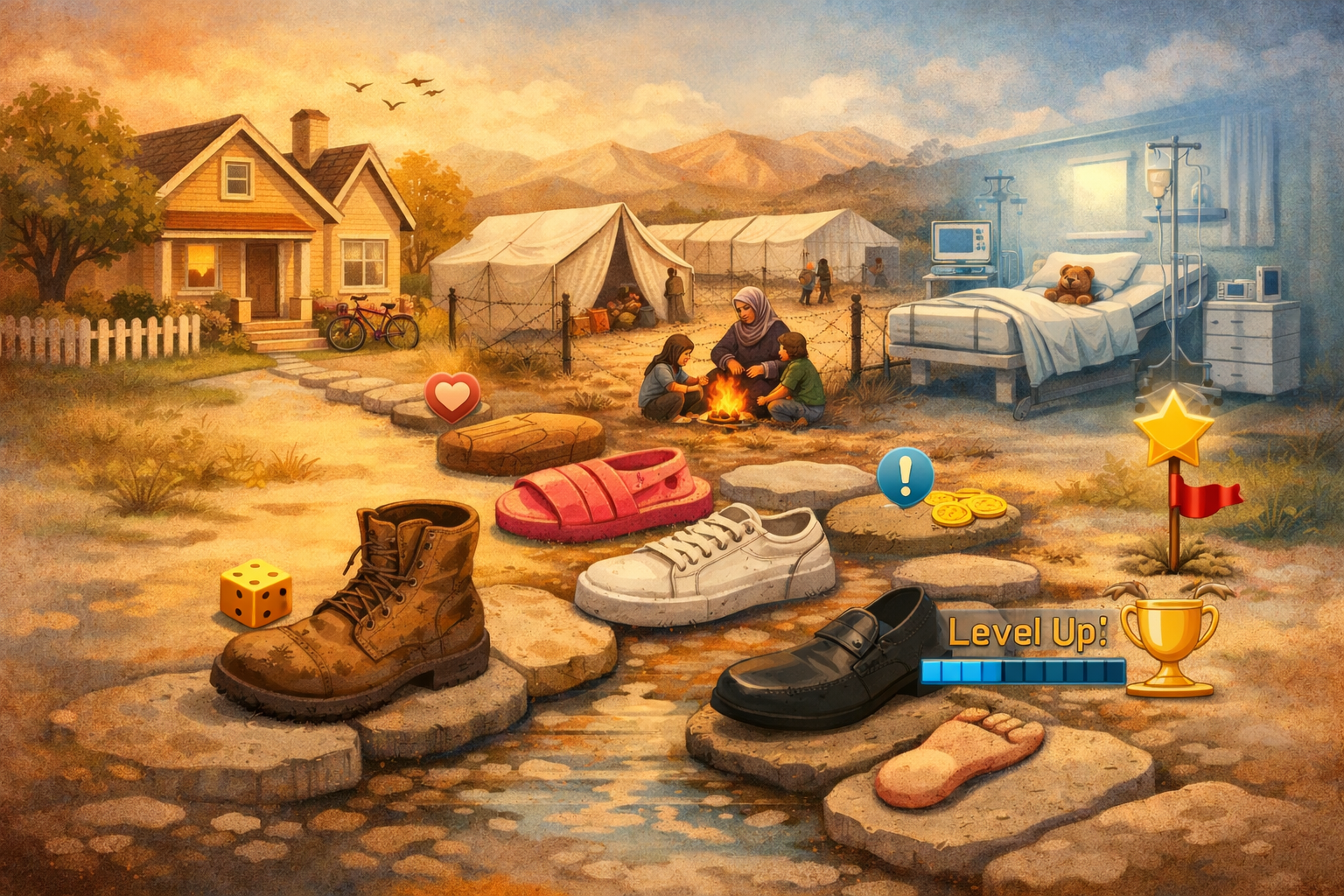
Before playing these games, I felt a bit overwhelmed by the fact that I had to play seven of them, especially since they all tackled heavy topics. Although I did feel that heaviness at times, it also made me realize how privileged I am to even have the option to pause, to breathe, or to take a break. For many people living these realities, there is no pause button. It is their life — not a game they are playing.
There were games I felt personally inclined to choose because I related to them, like Sleep Deprived Mom, Losing a Parent, and the Syrian Refugee game. I truly appreciated each and every one of them. Surprisingly, I feel like they were more healing than triggering.
There were other games that highlighted struggles I sometimes overlook simply because I have never had to face them, like Spent. That one was especially eye-opening. Spent was truly educational and was my favorite in terms of design and structure. The way it presented consequences and supported them with facts made it powerful. The other games all had beautiful and meaningful concepts, but if they adopted Spent’s structure and design elements, they would be even more impactful. I think that format allows players to step more fully into other people’s shoes and truly understand the weight of their decisions.
Overall, this was a very grounding experience. I hope it makes me more tender, more careful, more aware, more attentive, and kinder in the way I deal with people.


Provide Feedback