
Before we begin, know that we will be moving through different parts of the museum, and each space represents a stage of my creative growth and change. Welcome to the grand opening of the Museum of my creative metamorphosis. As you step through the tall, hand-carved cedar doors, take a deep breath and notice the air, which smells like old library books mixed with fresh morning rain. The museum feels calm and dreamlike, as if you have stepped inside a living thought. The walls are textured and layered with shifting colors, starting with deep blues that suggest reflection and slowly transforming into warm oranges and soft golds that represent hope and new beginnings as you move deeper inside. The lighting is gentle and warm, guiding you through the space without ever feeling harsh, while the quiet floors and open rooms invite you to slow down, observe, and feel. This is not just a place to see art, but a place to experience ideas, emotions, and transformation as you move forward through each part of the museum.
I am your guide, and today I am presenting the journey of how a shy freshman found their voice in a room full of strangers.
The Hall of Beginnings and The Circle of Trust
As we enter this first large gallery, look to your left. You will see an installation that looks like a classroom, but notice the floor. The chairs are placed in a perfect circle, with no breaks (this is our class setting). When I first walked into this class, I thought it would be boring. I felt uncomfortable as a freshman sitting with sophomores and juniors, and I even went back to my advisor to ask if I should drop the course. At that time, I was very quiet and preferred to stay in the background because I was afraid of being judged.

But notice the feeling we recreated here. Sitting in a circle, where everyone faces each other, made a big difference. It felt safe and welcoming, and it encouraged everyone to speak and participate, which made learning better. Above the circle, you can see gold plaques with our Community Agreements written on them. These were not just classroom rules, but lessons for life, teaching us to focus on ideas instead of people and to respect anyone who is speaking, even when we disagree. For me, the most powerful lesson was learning to respect people’s gender and pronouns. This was not common where I come from, but I learned how important it is so that no one ever feels disrespected or excluded.
The Chamber of Identity and The Single Story
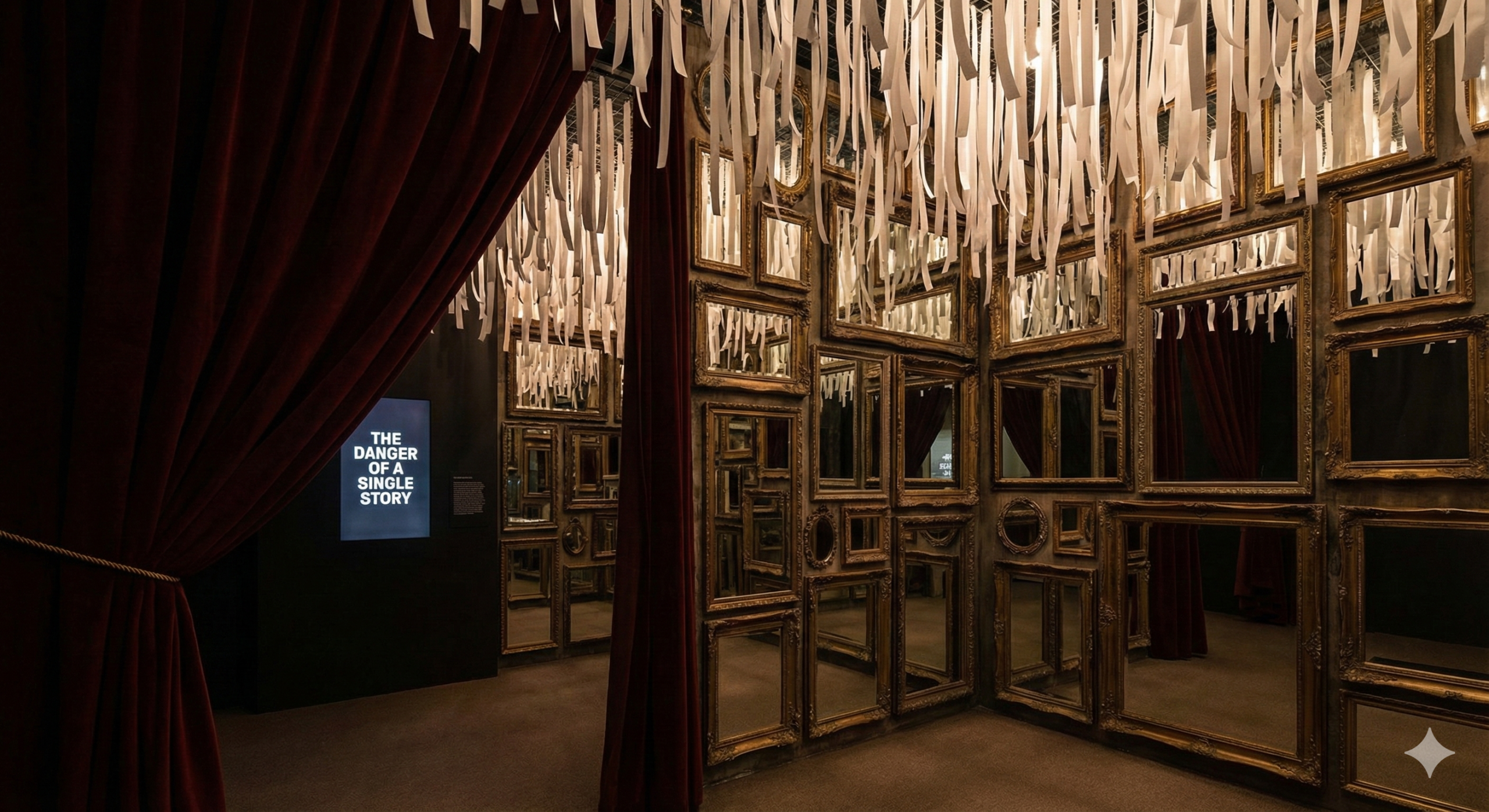
Step through this velvet curtain into a room that feels much more intimate. The walls here are covered in mirrors and hanging strips of paper. This represents the Identity Stripping Activity. It was deeply emotional for me. Being forced to physically remove the words that describe who I am taught me what I actually value at my core.

On this screen here, we are playing “The Danger of a Single Story.” It’s a crucial intellectual takeaway because it explains the mechanism of “othering.” I learned that stereotypes aren’t always born from malice; they come from incomplete, single stories repeated until they flatten complex human beings into a single narrative. It gave me a framework to understand the refugees in the BBC Syrian Refugees game or those in poverty in the “Spent” game. This connected deeply to my Soliya sessions, where I had to order my identities, nationality, religion, hobbies, from least to most representative. It made me ask, for the first time, if the world sees the same “me” that I do.
The Digital Alchemy Lab
Now, follow me into the most modern wing of the museum: the Digital Alchemy Lab. This room is filled with glowing holographic displays. Here, you can see how I became a “CEO” of my own creativity. What do you think I mean with that ?

Look at this first exhibit: my game. It was my first time making something that creative. I learned to use Gemini and ChatGPT as a team; when Gemini made a mistake, I called on ChatGPT to fix it. My role was to give the orders, but the process made me realize I was becoming more creative because I wanted to deliver something that would make my doctor and peers feel satisfied, not JUST to get a grade.
Over here, you’ll see my research into the Barnum Effect.. that psychological trick that makes people believe general TikTok descriptions of ADHD or OCD are specifically about them. I used two very different tools for this:
- Keenious: This tool felt like a helpful librarian. I opened my draft, and it analyzed my text to suggest academic papers. It bridged the gap between my thoughts and the scientific evidence I needed.
- Gemini Deep Research: This was a different beast. I gave it a mission, and it built a structured report, connecting the 1948 Forer Experiment to why we trust modern AI.
I also explored explored other AIs, and while reading the reflection of my colleague Mohamed N. Sayed I heard about NotebookLM, which I found incredibly neat for professionals, while Consensus was a disappointment.. it felt like a normal search engine and even failed to receive my PDF documents. This lab shows that tools are only as good as the person using them.
The Global Corridor and The Concept of Home
As we walk through this long corridor, the walls display maps of North Africa. We often questioned in class and in Soliya: How African is Northern Africa? There is a joke in Tunisia that we only feel African during the Africa Cup of Nations, and it actually happened this month as we lost in the FIFA Arab Cup. This reading challenged my identity, showing that being “from” somewhere is a complex mix of culture and language, not just geography.

This leads to my GCC experience. I had a discussion with Zoe and Youssef about tourism. I used to think that being “nice” meant giving tourists space and not talking to them so as not to bother them. But Zoe told me she actually loves it when people talk to her and make friends! It changed my perspective entirely. Now, I’d just say hi when I see a tourist, I just don’t need to overthink it 🙂
Look at this screen showing the ethics of Voluntourism. It shows how social media can make volunteering look like fun and games, but it often hides the negative effects, like children getting attached to volunteers who eventually leave. It reminded me that “Home” is not just a place on a map; as I explored in my Soliya Reflection, home is where you feel comfortable and appreciated.
I made a short video about what is HOME for me, kindly check it from this link 🙂
The Architect’s Office
Before you leave, step into my small office at the back. If I were the architect of this course, I would suggest two changes. First, the two-minute papers should be one open paragraph of free writing. We students love the freedom to elaborate in our own tone without being restricted by seven specific questions. Second, I would move the mid-semester self-reflection much earlier. It’s important to know your mistakes while there is still time to make progress, rather than finding out at the very end of the semester, which unfortunately happened to most of us.
The Final Exhibit: The Kind of Person
As you exit back through the grand mahogany doors, you will see a single sentence etched into the stone above the archway: “A person who should take this course is someone passionate about life and curious about everything—because this course is going to teach you everything in the easiest and most interesting way.”

Thank you for walking through my journey. You can find the artifacts I mentioned here:
How and why I used AI ?
I know that the final reflection would look better if I fully write it without AI, but I used Gemini to help structure my thoughts into this “Imaginary Museum” theme and to help describe the visual details of the rooms to make the reflection more creative. I had the idea and vision but didn’t know how exactly I would state it so the reader know what I thought of and how it looks like in my mind. I provided all the specific personal reflections, tool comparisons, and course experiences myself. The doctor want to hear MY reflection, that’s why I asked the AI not to change anything especially in the tone of writing because they always ruin it for me, and I don’t get the expected result. The creative idea of the museum required me to use AI. However, they did not generate for me, I spent around 3 hours in a google docs file, collecting everything I will talk about, and writing the reflection and everything. Then the AI helped me in the final product
You can view my interaction with the AI tool here: link.
What I would do differently if I had more time?
This is not part of the reflection, and I was not asked for this but I really need to mention it. If I started this early, I would’ve done something much better. I am a very creative person and I always want to do things in a fun and different way. I thought of 3 ideas but they all require a lot of time:
- I make a video, everything in a video, the reflection will be all in a voiceover made by me, and there is a background music made by me playing the piano. I really wanted to do that and imagined how people would react about it. I will play a different piece in each room of the museum, and the visuals will be AI generated, so people will actually feel the vibe and the smell of the museum. I don’t want them to get bored, I want them to know that this reflection is REAL. And each feeling and experience I talked about was actually impactful.
- I make a presentation; a presentation on canva will be very interesting, and it will also be about the museum. The slides will be perfect and each one takes us to a different part of my journey with the class.
- I make a game simulation. Like the game we did in class, it will be a whole new simulation about my reflection, but instead of different endings, it will have different impacts, each part “intellectual” “Digital Literacy” etc.. and how it impacted my life (personally, academically, and in my career)
The most one I thought of was the first one, but unfortunately i didn’t have any time. I was overwhelmed by the exams as I had 18 credits this semester and couldn’t balance between the courses to make a perfect thing because it actually requires a lot of time. I wanted the video to be shown to the next cohort but when I found that I didn’t have time, because after exams I traveled back to Tunisia. And now I’m sitting in my desk where I spent my childhood imagining myself becoming a better version of myself. I chose to let the audience imagine my imaginary museum. I hope everyone had fun reading about my journey 🙂 I will miss you all !


Provide Feedback