Heyy guys! This is my thorough reflection of the games I played; I hope you like it.
Spent:
Before Playing:
Before playing, I was a bit curious how it would be, but also skeptical if it would be beneficial. When I knew that it talks about the struggles of American families, I wasn’t expecting that there would be major problems and that they wouldn’t have major sufferings.
During the Game:
During the game, I started to feel how Americans also face struggles with their finances. A harsh decision was letting go my car repairs because it would drain my savings, which touched me because I love cars. In addition, when rent was due, I paid it right away which left me with little for the rest of the month, but I had less debt. The hardest decision for me was paying off the credit card, which I think is a very big problem that young Americans face, which ended putting me in a financial difficulty. However, I was able to continue the month with a little amount of money at the end because of what I saved.
After the Game:
After the game, I realized that Americans do have problems in their lives, but they can be different from what we, Middle-easterns, face. They have their own struggles regarding their finances that would put them in harsh conditions where they should take a decision that would lead to negative consequences in both cases.
What I learned:
Financial stress can impact everything in our lives from our relationships to our mental health. It’s all about survival. In addition, poverty is a cycle, especially when being in debt, which is very hard to escape once entered. Finally, I learned the Americans’ struggles they go through related to their finances and how it affects their daily lives.
Suggestion:
I would suggest adding phone calls to the game to make it more interactive and more related to what happens in reality.
Link: https://playspent.org/
Syrian Refugees:
Before Playing:
Before playing, I was almost certain that this game would be beneficial. When I knew that it talks about the struggles of Syrian refugees, I was expecting that it would portray the major challenges they go through. I thought I had an idea of their suffering, but I wasn’t sure if the game would truly reflect their reality.
During the Game:
During the game, I started to feel how difficult life is for Syrian refugees. A tough choice was deciding whether to pay a smuggler to help me cross a border, which could be dangerous but was the only way to continue living with dignity. Food and shelter were also major challenges. At one point, I had to choose between using my remaining money for food or saving it for an uncertain future. It was difficult because either choice could have serious consequences. The hardest decision for me was whether to risk an unsafe journey by sea. I knew that many refugees had drowned trying to cross, but there weren’t many alternatives. This decision really showed me how desperate people must be to take such risks, and how they can risk their lives just for a chance of a better living.
After the Game:
After the game, I realized that the struggles of Syrian refugees are even worse than I had imagined. It’s not just about escaping danger, as it’s about surviving every single day with limited resources and uncertain outcomes. Their lives are full of impossible choices where every option leads to hardship for just a small chance of living a better life.
What I Learned:
Constant fear and instability can impact everything in our lives. The Syrian struggles are real; it’s all about survival. Finally, I learned more about the struggles that Syrian refugees go through and how every decision the make affects their future and that leaving their country is not the solution for their problems but can sometimes be just the beginning.
Suggestion:
I would suggest also adding the difficulties faced by Syrians in Syria itself, not only when they get out of their country as refugees, as I think they can be more difficult experiences.
Link: https://www.bbc.com/news/world-middle-east-32057601
Empathy Toy
Before Playing:
I thought the game would be like a puzzle without any meaning behind what we do.
During the Game:
I started thinking of how challenging being blind can be. In addition, it showed that teamwork can be a very important contributor to the success of blind people because when we helped each other in explaining the steps required to connect the puzzle, we were successful in doing so.
After the Game:
I started being more aware of the challenges faced by blind people in their daily lives and how important is trust and our help while working with them.
What I learned:
Empathy is all about putting yourself in someone’s shoes. Although I wasn’t the one blindfolded, I still had a sense of how difficult it can be without sight and how small efforts in explanation can make it much easier for blind people.
Suggestion:
I would suggest playing this game with a blind person, which will make us realize their hidden talents also not only the challenges they face.
Link: https://twentyonetoys.com/pages/empathy-toy?srsltid=AfmBOopaLlVubgthDBswnBRQIY08zOw4w0t0ROeAXElgfki18oDpPtkN
Bury Me My Love:
Before the Game
I expected a typical narrative experience, but I didn’t realize how deeply it would be in terms of their texting on everything that is happening.
During the Game
I started off feeling like I was just following a normal conversation, but when the bombing happened, everything changed. The frantic search for information and the rush to help made me feel the pressure of real-time decisions. I was genuinely worried for the characters while anticipating the responses in the chat.
After the Game
This game left a deep impact on me. It didn’t just tell a story, as it made me feel the fear, urgency, and helplessness of life in a conflict zone and how every message can carry weight.
What I Learned
The game made these realities feel personal. It showed how people in war zones live with uncertainty yet still find ways to help and keep going. It reminded me how easy it is to be detached from tragedies until you see them through someone else’s eyes, especially in texts like these.
Suggestion:
I would suggest integrating between the prologue in the texting and real life scenarios that are live to make it more interactive.
Link: https://burymemylove.arte.tv/prologue
September 7th, 2020:
What I Liked
I appreciated how the game realistically portrayed the difficult choices students had to make as in whether to attend in-person classes, socialize, or prioritize mental health. The way small decisions led to major consequences made me reflect on how every action carried weight during the pandemic.
What I Disliked
At times, the game felt frustrating because no option felt truly “right.” While this accurately reflected the uncertainty of 2020, I sometimes wished for more choices to mitigate risks.
What I Learned
The game reinforced how students had to balance education, health, and financial concerns with clear guidance. It made me appreciate the complexity of decision-making during that time and the and the psychological effects it had on the students.
Possible Improvements
Adding more varied outcomes and perspectives, such as insights from professors or family members, could make the experience even more immersive. A follow-up section showing the long-term effects of different choices would also add depth to the whole picture.
Link: https://caitkirby.com/downloads/Fall%202020.html
Reflection on October 1st, 2020
What I Liked
I liked how the game highlighted the difficult trade-offs faculty had to make, from adapting to online teaching to supporting students while dealing with their own struggles. It showed the human side of professors, making their decisions feel personal rather than just their role as a professor.
What I Disliked
It was frustrating to see how little control faculty had over institutional policies. While realistic, it sometimes felt like no choice would truly solve the challenges, making the experience very challenging.
What I Learned
I gained greater appreciation for the pressures faculty faced while they are balancing student needs, their own well-being, and university expectations.
Possible Improvements
Including more direct interactions with students could add depth to the whole picture of the struggles professors faced during COVID. In addition, more flexibility in solutions, such as experimenting with new teaching methods, could make the experience feel less restrictive as I would think that this would mitigate the problem even for a little bit.
Link: https://caitkirby.com/downloads/October1st2020.html
Responsible Partying:
What I Liked
I liked how the game allowed me to make choices that aligned with my values without feeling pressured. It emphasized the importance of setting boundaries while still enjoying social events, which felt both realistic and empowering. However, it was very hard to do so when everyone around me made it the norm to drink and hook up.
What I Disliked
Some scenarios seemed overly simplistic, as if the only choices were extremes and the peer interactions could have been more engaging.
What I Learned
The game reinforced that responsible partying isn’t easily done and that I could be affected easily by others.
Possible Improvements
Adding more social dynamics like dealing with peer pressure could make the experience feel more authentic. More options for different personalities and approaches to socializing would also add depth to the whole picture of responsible partying.
Link: https://docs.google.com/presentation/d/1FUGGJrxTjq9YnmcRGJKG_CsX1npnBy9LpSrlYVAgiNE/mobilepresent?pli=1&slide=id.p
Comparison between the Games:
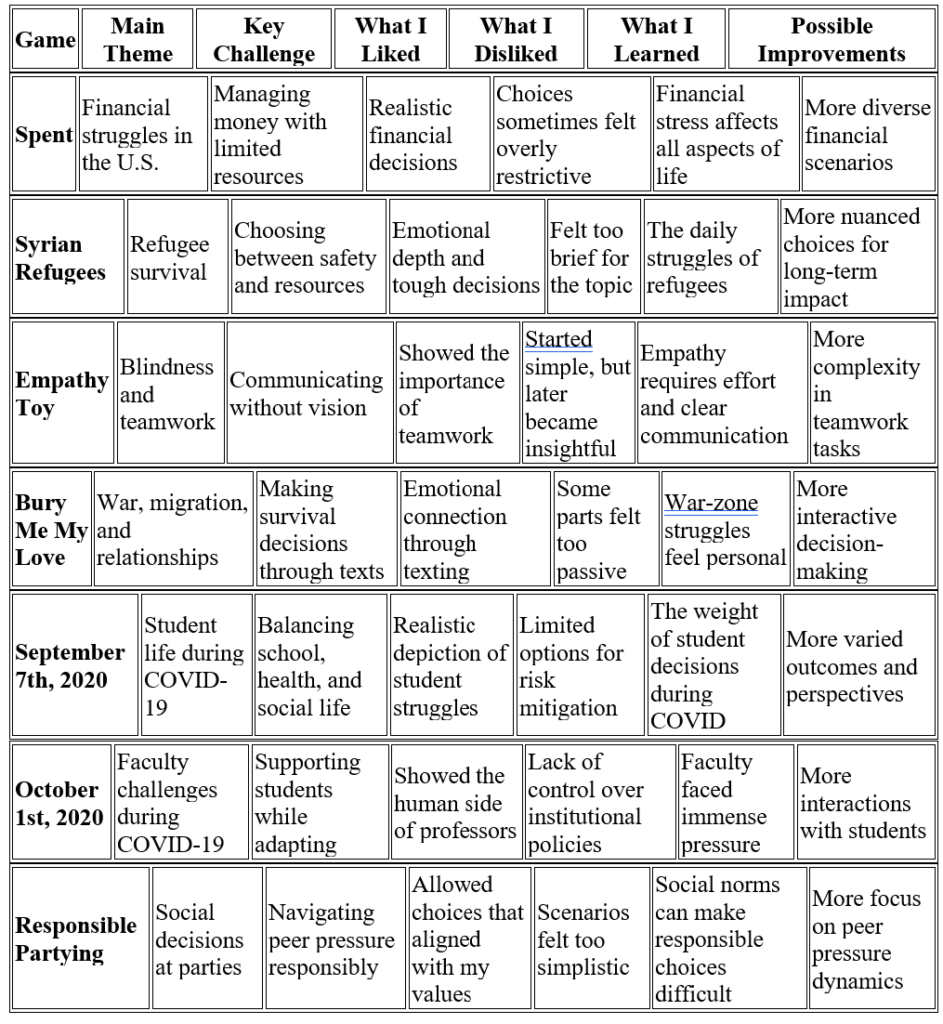 Note: ChatGPT helped me structure the table.
If you have any questions, please let me know 🙂


hi Faris, you forgot to play student-created games – you were supposed to do at least two of those from the list.