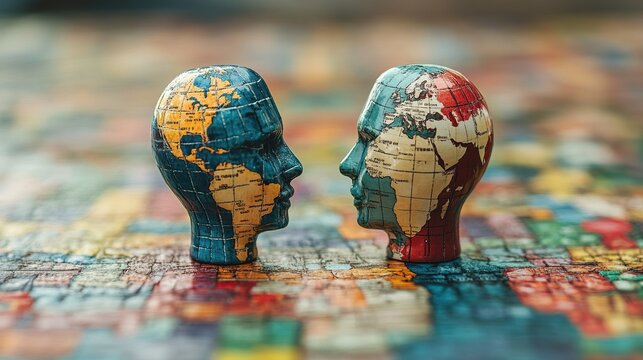
What have I learned intellectually? I find this quite a difficult question to answer. Not because I have learned nothing, but quite the opposite. Most of the topics we covered so far in this course do not seem like something I would expect to learn from an academic course, but more as putting a spectacle on things I have encountered in my life, making them a lot clearer and well defined. There were three assignments that I found particularly interesting throughout this course.
The first of these three was one of the TED talks we discussed, “How Language Shapes the Way We Think?” This talk was interesting because it taught me about how language can shape people’s perspective of every aspect of life, such as something as simple as directions. The part about the Aboriginal community using a completely different way to talk about directions was fascinating, and it showed me that language can alter people’s perspectives at such great scale. This was a very interesting lesson to learn, but then I started to see how this is very true even in my personal life. I started to notice the small differences between languages to describe the same thing, or cultural differences that cannot be expressed through language.
The second was Lina Mounzer’s “Finding Truth and Beauty.” This article put into words something that I have seen and thought about previously, but never in this level of detail or eloquence. The description and metaphors of translation were very fascinating and gave me a new perspective on language. I found the TED talk to have been a great watch before this article as it felt like a foundation to Mounzer’s description of translation. It taught me that translation is not simply difficult because the new language is foreign to the original author, but because there are worlds of difference between the culture and history behind every language which cannot be done justice by the limits of the new language and the translator’s proficiency in both. The transplantation metaphor is something that still sticks out to me. Describing translation as taking a plant or organ and transplanting it to a new host is a perfect metaphor. This goes beyond translation, as I believe this also applies to linguistically translating an experience, regardless of language
The final was when we talked about hybridity. Defining hybridity gave me a different perspective on what forms a person’s world view, personality, and experiences. This was particularly interesting when we discussed the TED talk “Don’t Ask Where I’m From, Ask Where I’m Local.” This TED talk took away the simplicity of saying “I am Egyptian,” and dived into the more complex circumstances that form someone’s identity. This was very interesting and it gave me a whole new view on the experiences and situations that form the identities of anyone I interact with.
These were the main assignments that stood out to me due to the interesting and very relatable lessons they teach. I did not expect that I would learn a lot about what defines my identity while simultaneously appreciating the differences between languages and culture. Before the course, language was just for communication, and while I noticed that speaking in different languages made me a slightly different person, I never really understood that difference. Now, I see language as a lens that filters how we perceive reality. I have become more aware of the cultural mindsets and linguistic difference.
My Soliya group is quite diverse, despite half of it being Americans, however there is one thing I have noticed. Regarding the topics we discussed, we all have quite similar opinions despite our vastly different experiences. Growing up I was surrounded by people from all over the world, so I was not really expecting to learn much from my Soliya experience. However, one thing stood out to me, and that was the way some people described their experiences. I heard people discuss very traumatic experiences with a scarily casual attitude, situations which I have never encountered someone who lived through. This was a very shocking but fascinating thing to see and it really reminded me about some of the things we discussed throughout the course, such as empathy vs compassion. It also reminded me of Mounzer’s idea that some emotions cannot be fully translated, whether into words or another language.
If the issue of Palestine came up in Soliya, I am not really sure how it would go. To me, this is one of the topics where I really will not even attempt to hear out anyone who’s opinion opposes mine, so it really depends on what the rest of my group would say. I would not be able to direct this sort of discussion as I am (rightfully) biased.
Overall, this course has not only taught me about intercultural communication but also made me more aware of my own biases and assumptions. I now understand that every conversation, translation, or cultural encounter is shaped by complex histories and emotions. It encouraged me to listen more carefully, to reflect before reacting, and to value the beauty that comes from difference rather than uniformity.


1 Pingback