
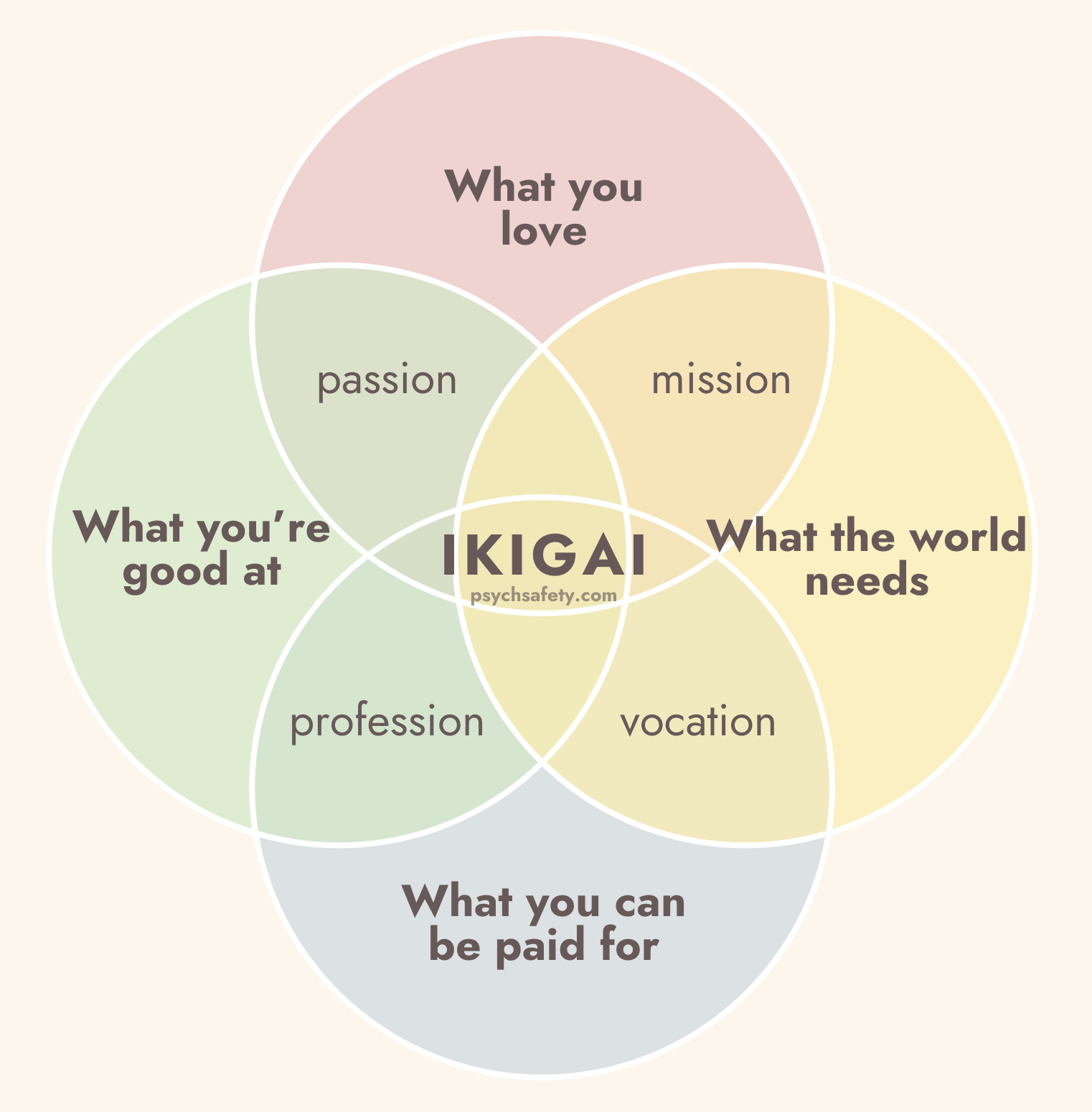
For this assignment, we were first asked to explore our ikigai. Ikigai “is a Japanese concept that means ‘your reason for being’. It refers to the source of value and joy in your life and what makes you feel that your life is worth living. It is the force that gets you out of bed each morning.” I found this concept a very unique way to approach finding one’s calling in life since it merges a person’s passion, mission, profession, and vocation. However, to reach this point, we have to first think of what I love, what I’m good at, and what I think the world needs. Here’s a diagram displaying what an ikigai is:
My Ikigai is as follows:
- I love late night drives with friends and deep conversations, but I mostly love anything to do with nature (especially mountains)
- I’m good at listening, being attentive, and expressing my emotions through art
- I think the world needs more people who help strangers out without expecting anything in return
–> Passion (what I love & what I’m good at): Art Therapy in nature
–> Mission (what I love & what the world needs): Potential mission statement using Google Gemini: “To cultivate spaces of beauty and vulnerability—inspired by the stillness of nature—to inspire a selfless spirit of attentiveness and goodwill toward strangers.”
Next, we took a survey to know what our strengths are to help us develop a game. So, in order to find our strengths, we took the via survey where we were asked simple questions about ourselves.
The results of my top 5 character strengths according to the VIA survey:
Your Top Strengths

Noticing and appreciating beauty, excellence, and/or skilled performance in various domains of life, from nature to art to mathematics to science to everyday experience.

Being careful about one’s choices; not taking undue risks; not saying or doing things that might later be regretted.

Speaking the truth but more broadly presenting oneself in a genuine way and acting in a sincere way; being without pretense; taking responsibility for one’s feelings and actions.

Doing favors and good deeds for others; helping them; taking care of them.

Mastering new skills, topics, and bodies of knowledge, whether on one’s own or formally; related to the strength of curiosity but goes beyond it to describe the tendency to add systematically to what one knows.
Idea of a game I can do using my Ikigai and VIA results (by Gemini):
For this section, I entered my ikigai and via results into Gemini and asked it “to generate ideas about a game I should make.” This was too vague for AI so I had to instruct it to make me more of a narrative or role-play game. I liked the game concept it made but wanted to increase the stakes so I asked for it to make the game have a survival aspect. Here was the final result:
Game Idea: Whispers on the Ridge: Solitude’s Burden (A Survival Narrative RPG)
The Core Concept
You are a solitary trekker attempting to cross a massive, unyielding mountain range. The game is played across two intertwined meters:
- Physical Condition: Your basic survival needs (Hydration, Warmth, Energy). If these drop too low, your cognitive functions suffer.
- Moral Compass: Shaped by your answers to the constant philosophical and ethical questions.
Gameplay Loop & Mechanics
1. The Survival Layer (Prudence & Attentiveness)
- Resource Management: You must constantly manage limited food, water, and fuel. Prudence is key—you cannot afford rash decisions.
- Environmental Risk: The wilderness is harsh. Bad weather, injury, or misjudging a path severely impact your Physical Condition. You must use Attentiveness to spot subtle clues like animal trails or shifting weather.
- Decisions of Necessity: Survival choices are presented as multiple-choice questions:
- Example: “You spot a small, wounded deer. You are starving. Do you: A) Take the deer for sustenance; B) Spend precious time and resources to help it heal; C) Ignore it and move on?” (Tests Kindness vs. Prudence).
2. The Narrative Layer (Deep Connection & Honesty)
- Philosophical Interventions: At regular intervals (e.g., reaching a new vista, finding a ruin, or when your Physical Condition is critically low), the game prompts a question for introspection.
- Example: “Under the weight of exhaustion, you wonder: Do acts of Kindness matter if no one but the recipient (or yourself) ever knows about them? A) Their value is solely internal; B) Their true value requires external recognition; C) I am too tired to consider this.” (Tests Honesty and belief in Unselfish Kindness).
- Question Consequence: Your answers accumulate to shape your Moral Compass. A strong Honesty score might unlock new, more direct dialogue options later. A high Kindness score might cause a seemingly random beneficial event (like finding a hidden supply cache left by a previous traveler).
3. The Art/Beauty Layer
- Appreciation of Beauty & Excellence: Even when struggling, moments of stunning scenery are forced upon you. Pausing to Sketch (your art skill) the view consumes time (a survival cost) but provides a temporary boost to your Moral Compass, reflecting the restorative power of nature.
- Love of Learning: Finding ancient markings or forgotten trails triggers questions about the mountain’s history or local flora, rewarding correct answers with temporary survival buffs or new paths.
The core challenge is this: Can you survive the mountain’s physical demands without letting its solitude compromise your moral integrity and commitment to unselfish kindness?
My Reflection:
Answering the three main ikigai questions took longer than expected when answering them with my partner because although they seem very straightforward, they were never things I thought about independently. I couldn’t think of a passion or mission for myself based on these results so I asked AI however I didn’t agree with most of the options it gave me, which led me to believe either I’m not certain about my true ikigai answers or that AI can’t find an answer that I relate to.
When I was answering the questions in the VIA survey, it really made me stop and think about my actions, especially towards other people, in a way I haven’t thought about before. I think it’s the way the questions were phrased that caused this self-reflection and contemplation, and it also made me think of revisiting this survey again to see if my results change over time. The results were scarily accurate in a way that I felt exposed and perhaps ashamed, for not valuing or having more honorable qualities like fairness or gratitude. But overall, I enjoyed the process and appreciate knowing this information about myself.
I then asked AI to create a game based on these two results and it definitely required me explaining more than this data (ikigai and via results) for it to make a game I was passionate about. But I would be excited to execute the game AI generated above titled “Whispers on the Ridge: Solitude’s Burden” since it reflects my interests. Another game I would love to do is a Palestinian refugee game since both my grandparents are Palestinian and could provide me with valuable insights. But I would want for this game to include other nationalities in the story to make it more relatable. I feel that although AI gave me a nice game that reflects my interests, I would want to make the game more personal in a way that AI could never reach regardless of how many times I prompted it. This is why I would rather make a game with as little AI influence as possible because the best games are the most personal.
I used AI in fixing grammar mistakes, finding my passion and mission from ikigai results, and generating game ideas.
Click this link to view my full conversation with Google Gemini.


I really appreciate your self-reflection and vulnerability. I agree that any human-invented game is sure to be more interesting than an AI generated one. I think your idea for a Palestinian refugee game is unique and would be fun!