Part 1
Empathy Game (offline game) https://twentyonetoys.com/products/empathy-toy-facilitators-kit
The empathy game was truly a mind-altering experience. The version of the game we played involved 3 to 4 participants. 1 to 2 participants used wooden blocks covered in textures to build a structure. The other 2 participants covered their eyes with blind folds. One of them holds the structure and feels it and describes it and the other uses the description to attempt to build the same structure. While playing the game I felt frustrated that that I couldn’t explain to my partner what I was touching. This led me to think about how tough it would be for someone visually impaired to describe such a simple object to someone else. I learned through this game to feel empathy towards those who have disabilities especially visually impaired individuals. One thing I would change about the game is that I would want to add other sensory elements such as exploring scents and sounds rather than the sense of touch only.
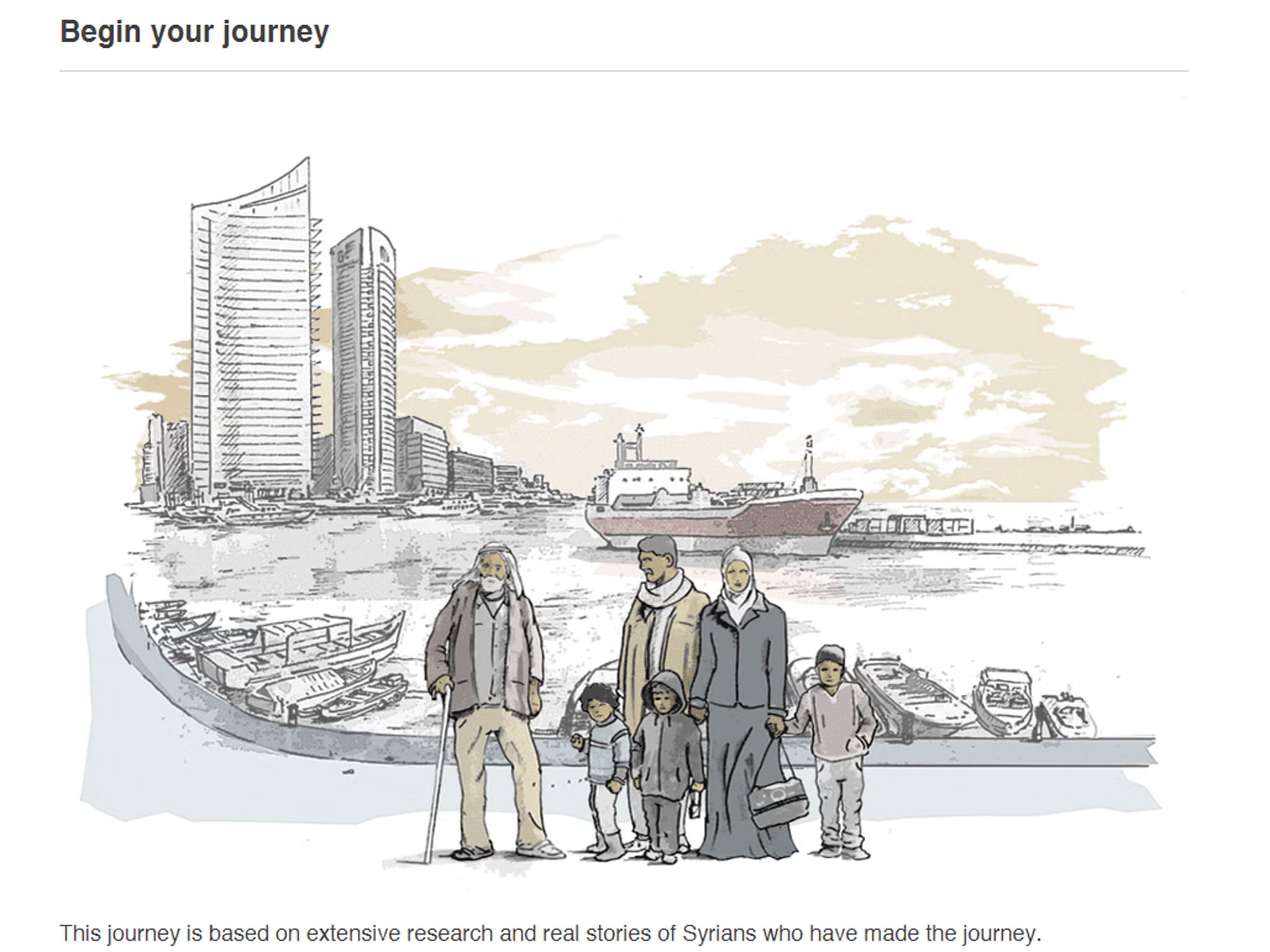
Syrian Journey: Choose your own escape route https://www.bbc.com/news/world-middle-east-32057601
This BBC interactive game is a simulation based on the scenario of Syrian refugees attempting to flee the country with hopes in ending up in Europe. Throughout the game you have to make several choices about how they should escape, and each choice builds on the previous. The first time playing the game I felt tense and had no idea which choices to take; there were so many options and they all seemed risky. Either an option would be safe but would come with the risk of getting caught such as traveling by land or would be dangerous and have less risk of getting caught such as traveling by sea. I learned from this first play through that there is so much uncertainty that refugees face, one decision could seem the safest at first however it could lead to their demise. The second time I played the game I felt more prepared. I was more familiar with the choices and their outcomes. I also learned how a minor change in the decisions refugees take can result in completely different outcomes. Even if refugees take the safest choices there are external factors beyond their power which are working against them, whether border control, shipwreck or family separation. I would have loved for BBC to add at the end of the game a few links to different Syrian refugee funds as I feel it would be fitting to give people the platform to help, after learning about the hardships refugees face.
SPENT https://playspent.org/html/
SPENT is an online game in which players take on the role of a parent who is looking for a job and is trying to survive on only $1000. The game involves making decisions in regards to healthcare, food, emergencies, housing and employment with the aim of lasting the whole month without running out of money. When I played the game for the first time, I felt it would be easy to last a month on a thousand dollars but what I didn’t realize is how many small purchases can create a dent in someone’s savings. I didn’t imagine that there would be “emergencies” or the possibility of my character losing his job which is why I unfortunately couldn’t make it till the end of the month. I learned that having such a small budget means having to anticipate emergencies and problems which could arise at any point. The second playthrough, I was very cautious with how much cash I had remaining after each decision. I knew that I had to be more selective and choose to pay for the essential costs whether for my character or his child. I learned that people in poverty may even have to sacrifice the essentials for themselves to ensure their children survive. I like how at the end of the game there was a link to donate to those in need in Durham. I feel like what would make this game even better is if you could play in different regions of the world, having the costs of living adjusted, so that people around the world can understand how someone living in poverty would live within their country of origin.
Manufactured Evil https://docs.google.com/presentation/d/1bDaSkTsljnGfVV-MF0prClY8avdriIT5xRWliV0WxlI/edit?slide=id.p#slide=id.p
Manufactured evil is an interactive game which discusses the wicked problem of plastic pollution. The game begins by choosing either to play as the president of the Philippines or as a regular citizen. There are several scenarios provided and you have 2 options and have to pick to either make the sustainable choice or the unsustainable choice. I felt very intrigued playing the game and started to think about all the day to day choices I make which could be negatively affecting our environment. I was shocked to learn that plastics take 400 years to decompose. I previously knew that they took longer time than say paper but I didn’t expect it to be so drastic. I can now see more clearly why plastics accumulating in our oceans is a major problem. I loved how after each decision we were either praised for making the correct choice or guided towards it had we chosen to be lazy and opt for the plastic options. Moreover, I liked the idea of playing from the point of view of a policy maker and got to understand what kind of legislative actions can be taken to reduce plastic production and consumption. I would’ve liked for the game to address as well how the production of plastics inherently harms our environment through large carbon emissions rather than focusing only on the pollution aspect. This can help strengthen the argument of looking for alternatives to plastic.
Being Under the Influence https://docs.google.com/presentation/d/1b4QR2t-NY7znz8yZIHa9hcn82iSvPJJvMo7mp_FEW_o/edit?slide=id.p#slide=id.p
“Being Under the Influence” is a well thought out game which takes you through the life of a teenager who experiences peer pressure at a party to drink alcohol and use illegal substances. Each action taken builds on the one before so it follows a story. I felt very sceptical at first when I was playing the game. I’ve always heard about peer pressure but I never really thought how big of an impact it could have on someone. As I continued playing the game I started to feel concern for the people around me who I’ve watched fall into the trap of peer pressure. I learned through this game the fatal impacts of driving under the influence and how the use of drugs can result in a downwards spiral of problems. I loved how the creator of the game included statistical infographics at the end of the game as I feel they helped strengthen the message. I feel like it could’ve been helpful to include sources that people could use if they struggle with substance abuse.
Sleep Deprived Mom https://docs.google.com/forms/u/1/d/e/1FAIpQLScap1su2i270VXK3DtWGWA683lyU6UkXJer_cSpN2tl0rXCjQ/formResponse
“Sleep Deprived Mom” is a hilarious simulation like game where you take the role of a mother with a one barely potty-trained child and no nanny and are given several scenarios and based on your choice you could lose hours of sleep. While I was playing this game I could not stop laughing and I started to feel kind of bad for my mom who I’m sure I sleep deprived when I was younger. I love how no matter which option you chose in each scenario you would end up sleep deprived somehow. It brought me back to when I was in elementary and would wake up my parents practically each night with a different excuse. I gained a better view on how mothers have to sacrifice something as important as sleep regularly, to ensure their child feels safe and comfortable. I feel like if the game included some sort of mood score which could track the mom’s mood throughout the simulated week it would be even more realistic.
Reality Check https://mediasmarts.ca/digital-media-literacy/educational-games/reality-check-game
Reality Check is an animated game which involves trying to discover whether social media posts are factual or fake. It takes you through a series of steps to verify the information used in a post. This game has made be feel more curious about the validity of the news I hear about each day. Whenever I hear a shocking piece of news, I immediately assume it is false as in this day and age the ability to fabricate information is easier than ever. I learned to use verification techniques such as reverse searching images, looking up the author, checking the date of publication, using a fact checking website, using encyclopaedias to gather more information and much more. I liked how the posts looked realistic; it was very similar to Facebook and Instagram which caught my attention. I wish the game included actual resources which we could use, like links to fact checking websites as it would have been very helpful.
Comparison
All of these games shared one goal, which was to educate us about a certain problem, raise our awareness and make us more empathetic through a decision-based game. The Empathy game made me feel frustrated at first but simulated a fraction of the difficulties visually impaired individuals face. One the other hand, “Being under the influence” and “Manufactured Evil” both discussed societal problems which really needed to be addressed. “Syrian refugee” and “SPENT” had me tense, but ultimately taught me the most about survival instincts, sacrifices and the uncertainty that people living in poverty and refugees face. “Reality Check” was truly informative and provided the most day-to-day life applicable information while the “Sleep Deprived Mom Game” added humour as an effective method to transfer the message that many mothers sacrifice sleep one way or another for their children’s sake.
Part 2
Ikigai
What do you love?
- Shopping
- Designing
- Creating
- Traveling
- Spending time with family
What can you be paid for?
- Finance related work
- Selling jewellery, I design and execute
- Working as a TA
What can you get credit for in your course?
- Reflecting
- Researching
- Presenting topics
What does the world need?
- Innovation
- Ethics
- Equity
What are you good at?
- Being creative
- Advising
- Listening
The VIA Character Strengths Survey
Top strengths
- Love
- Self-Regulation
- Creativity
- Perspectives
- Leadership
AI’s Ideas For Narrative Games
I chose to use ChatGPT to gather some recommendations for digital narrative games using my Ikigai and VIA results. The AI tool provided me with 5 possible game ideas. Here is the link to my chat. https://chatgpt.com/share/69a0eb9c-c6e0-8007-ae8a-bfbcea85dcda
The first game is called “Ethical Empire: The Jewellery Collective”. The core concept is to play the role of a jewellery designer- entrepreneur who is launching an ethical brand. I liked this idea as it connects with my dream of being a jewellery designer; however, I feel like it would be a bit too difficult to execute. I like the ethical aspect as I feel I want to create a game which has some educational value whether to teach people to be ethical or empathetic.
The second idea is called “The Traveling Advisor: Equity Across Borders”. It involves making decisions from the position of a financial ethics consultant traveling to different countries helping communities build sustainable businesses. Players conduct research and present proposals. This game connects my love for traveling, my interest in ethics and what I’m currently studying which is business.
The third option is “The Reflective TA” game where players take the role of a teaching assistant navigating student conflicts, grading fairness, institutional bias and personal ambition. In my opinion this doesn’t really align with my interests. I did say in the Ikigai that I could get paid for working as a TA but that isn’t something I’d love to do. I also don’t feel that this game has a lot of potential educational purposes which is something I want to focus on when creating a game.
The fourth game is “The Innovation Lab: Designing the Future Core Concept”. Players lead a multidisciplinary design lab creating products that address social inequity. The gameplay would include prototype creation, pitch presentations, ethical impact scoring system. I feel like this idea is a bit vague, the concept of addressing social inequity is great but creating products to address it is a bit strange.
The final option is a game named “The Family Legacy”. It is built around the concept of playing a character who has to balance entrepreneurship, travel and family values. The game would include a relationships meter, financial sustainability simulation and a legacy outcome system. I believe that this is the best idea as I’ve always been intrigued by how my parents manage to live a balanced life juggling their career, family, hobbies and travel. I think this game can teach people the importance of living a balanced life and the multitude of benefits that come with it.
My Idea for a Narrative Game
One game idea I would love to work on is developing a decision-based game which teaches people to appreciate handmade products. The game would involve taking the player through the life of a jewellery maker where they have to make decisions which reflect the setbacks jewellers face. The hiccups along the way could include: the sawblade breaking, the piece getting scratched, the drill bit snaping, the printer jamming and so much more. At the end of the game the players discover that so much time, energy and efforts are poured into the production of a tiny piece of jewellery.


Provide Feedback