
Welcome, folks, to another interesting blog!
- In today’s blog, I will be talking about my journey with AI; how it’s been shaping both my academic pursuits and practical work in the field, as well as reflecting on two interviews that I conducted with one of the best professors in the biology department, Dr. Asma, and a seasoned professional, Dr. Mohamed Abdel Fattah.
Personal Reflection: The Importance of AI in Biology
Over the past year, my understanding of biology and my role in it have both started to shift. If you’d asked me a year ago what I thought about artificial intelligence (AI), I probably would’ve told you it was something for engineers and data scientists, not for someone like me who spends time thinking about cells, DNA, and microscopes. But after a few eye-opening experiences and conversations, I’ve realized just how wrong that assumption was.
At the beginning of my college years, I used AI tools while working on my projects (not part of assignments) and university competitions. I used to spend ages trying to make my points sound clear or figuring out how to organize my ideas. But with AI, I’ve had something like a brainstorming tool on standby helping me clarify arguments, restructure my writing, and just get unstuck. It’s not doing the thinking for me, but it’s definitely helping me think better and communicate my ideas in a smarter way.
AI has also completely changed how I approach literature reviews. What used to be a long and sometimes frustrating search through endless databases is now more efficient and, surprisingly, more exciting. With AI tools that summarize and suggest related articles, I can pull together research that’s much deeper and more relevant. I find connections I didn’t expect, and that’s helped me write papers I feel more confident about.
The biggest turning point, though, came during my internship in a few biotech labs. I was honestly blown away. The level of automation was something I hadn’t imagined: machines doing delicate tasks, AI monitoring equipment and experiments, and software generating detailed reports. In most cases, I wasn’t the one running the experiment; I was the one interpreting the data the system had already processed. It made me realize that biology, as I imagined it, has changed. And it’s not a bad thing. It’s more efficient, more precise, and strangely more human in a way because we now have more time to think, analyze, and innovate.
Part 2: A Shift We Can’t Reverse
Dr. Asma: a professor of biology at The American University in Cairo

As part of deepening my understanding of AI in biology, I had the opportunity to interview Dr. Asma, a professor in the School of Science and Engineering at our university. Our conversation was both reflective and forward-thinking. She described AI not as a passing trend, but as a transformative shift, something that has permanently changed the way biology is practiced, researched, and even taught.
One thing she said really stuck with me: “It’s hard to imagine biology now without AI, just like we can’t imagine life without the internet.” Given the fact that AI’s role is currently unmatched. I realized that we’ve moved past the point of asking if AI will play a role in biology. It already does, profoundly. Dr. Asma talked about how AI isn’t just speeding up processes; it’s enabling entirely new types of questions to be asked and answered, especially in areas like systems biology, bioinformatics, and personalized medicine.
The most powerful takeaway from our talk was her belief that ignoring AI in biology today would be like refusing to use a microscope in the 1800s. You’d simply be choosing to stay blind to the deeper layers of the biological world. That analogy made me reflect on how much I need to keep adapting and learning to stay relevant in a field that’s moving at an astonishing pace.
Part 3: The Cutting Edge of AI—Gene Regulation and Beyond
Dr. Mohamed Abdel Fattah: PhD student
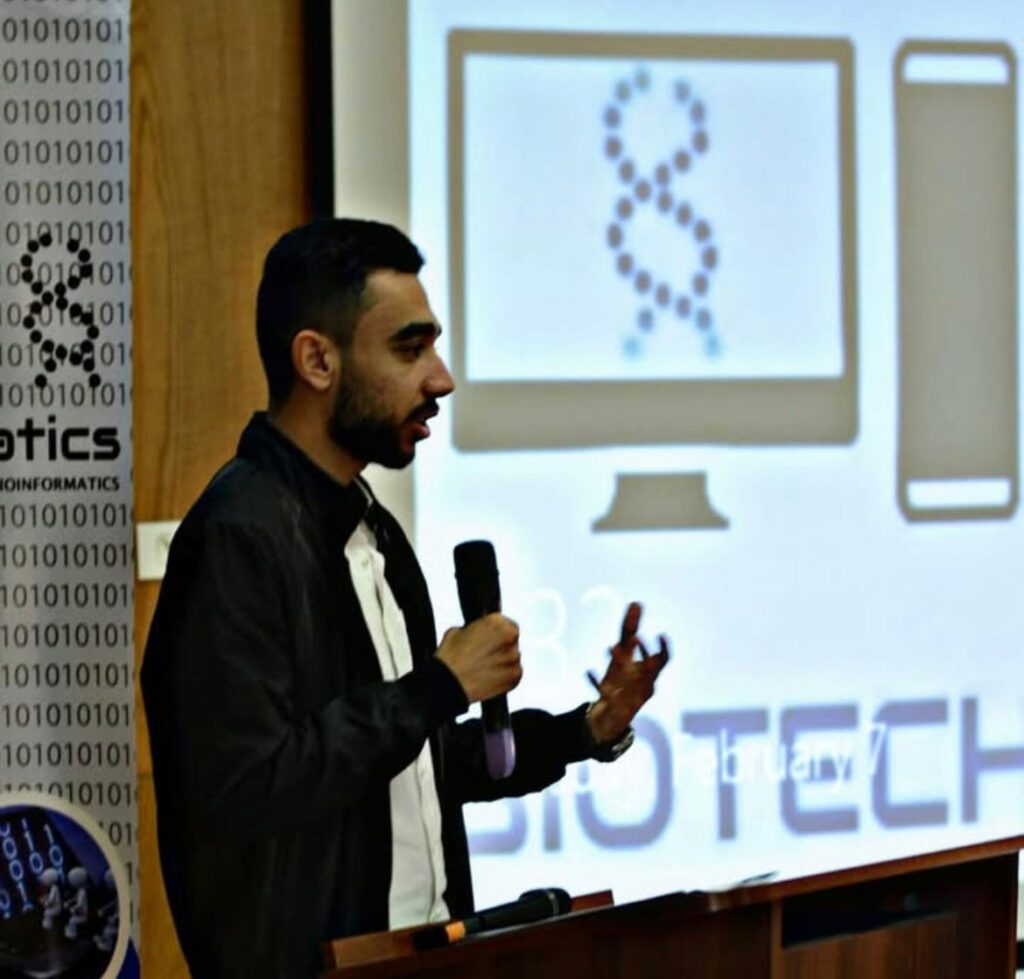
My last interview was with Mohamed Abdel Fattah, a professional actively working in the biotech industry. Our conversation opened my eyes to just how advanced AI applications have become in real, tangible ways.
When I asked him about the role of AI in his work, I expected a technical answer about lab automation or data handling. But what he shared went far beyond that. He spoke about using AI in gene regulation and enzyme design, particularly in the context of cancer treatment, and that is what he is currently working on. I was genuinely surprised that AI isn’t just helping with basic tasks; it’s now being used to design molecular tools that can potentially cure diseases. What impressed me even more was how he uses AI in his teaching. Mohamed works with students and young researchers, and he integrates AI tools into their learning experiences.
He explained that by using AI to model biological systems or simulate genetic interactions, students can engage with complex concepts in a more intuitive way. It reminded me how much learning itself is evolving alongside technology, so it is not just about research and sophisticated AI systems that are used in target gene therapy, it is about creating room for deep thinking, skepticism, and constant learning.
Part 4- a nutshell
Looking back on everything, from the papers I’ve written with AI’s help, to the labs I worked in, to the conversations I had, I realized just how much my view of biology has changed. AI isn’t this distant, high-tech concept anymore. It’s part of the world I’m learning to work in. It’s in the tools I use, the labs I step into, and even the questions scientists are asking today.
Now, I feel curious and motivated. AI is helping us uncover things we never could’ve seen on our own, from patterns in gene expression to designing enzymes to fight cancer. That’s incredible. And made me want to be part of that.
This journey has made it clear to me that the future of biology isn’t just about knowing how living things work. It’s also about learning how to work with the technologies that are helping us understand life more deeply than ever before. We don’t have all the answers yet, but by asking better questions, staying open to change, and learning as we go, we will be the ones who develop AI systems later on.
(In this essay, AI has been used for paraphrasing and grammar purposes.)
Thank you for your time and patience.
Please, if you have any questions, write in the comments.


Provide Feedback