Task 1: Summarization
For this function, I wanted to test each model based on the quality of the summarization and how each model is going to present its output.
Prompt Given: Summarize this paper in simple English.
The model was also provided with a document of my RHET 1020 paper and were asked to summarize it.
AI Tool: Google Notebook LM
Results:
The AI was able to summarize the paper and extract its overall outcomes based on how the paper was structured.
Here is a part of the AI output:
{High Costs: Producing high-budget games (AAA titles) can cost millions of dollars, and the necessary computer hardware (like advanced GPUs costing hundreds or thousands of dollars) is too expensive for schools or governments to purchase widely.
AI Tool: Consensus
Results:
AI here failed even to receive the pdf document, even after changing the file format from pdf to doc, the file did not get uploaded on the AI tool.
Task 2: Searching Academic Sources
For this function, I wanted to test the ability of each model for accessing and getting sources from academic journals. Also I wanted to the ability of the AI to follow the command of a more long and complicated prompt, since the prompt in task 1 was simple and without in additional instructions. I asked Chatgpt to write me a prompt to give the other tools.
Prompt given:
{Task: Conduct a brief literature review on the following research question: How does sleep deprivation affect working memory performance in healthy adults? Instructions: Find peer-reviewed academic journal articles only (no blogs, news sites, or popular science summaries). Use at least 3 distinct academic sources published in reputable journals. For each source, provide: Full citation (APA or similar academic format) Journal name Year of publication DOI or stable academic link (e.g., publisher page) Summarize the key findings of each study in 2–3 sentences. After listing the sources, synthesize the literature by explaining: Any major methodological limitations noted by the authors Clearly indicate where each claim comes from by referencing the corresponding source.}
AI Tool: Google Notebook LM
Results:
Part of its Output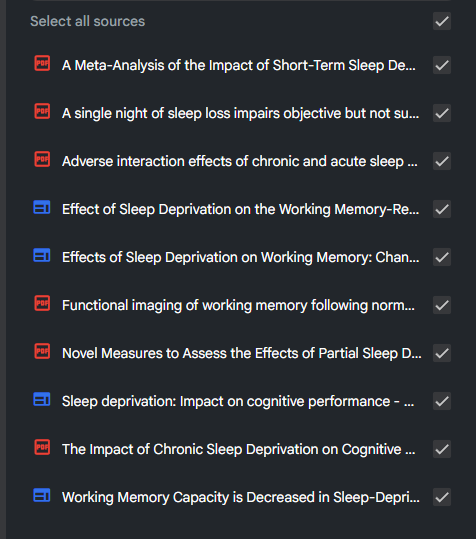
The results were some kind of promising but rather confusing. It did provide 10 academic papers, although I believe one of them was not academic. it did not create anything else beside gathering the sources, even though the prompt mentioned to summarize the findings of each source, the AI neglected this request and any others and without any APA citations.
Nevertheless: This AI model has the ability to clarify any amount of information it gets in very simple forms like mind map and an audio overview plus others.
AI Tool: Consensus
Results:
The results from this AI was more structured and followed the prompt as instructed. It provided citations, links, small summary for each source and how much the source was cited. The quality of sources varied from this AI. Some of them were academic and complete, while others were incomplete missing and requires access. One of the sources was only the introduction in pdf.
Part of the output:
-
Kurinec et al. (2025) found that total sleep deprivation (TSD) impaired the ability to update working memory (WM) contents, reducing accuracy in recognizing which information to maintain or ignore. This suggests TSD disrupts WM updating processes critical for adapting to changing demands 1.
-
Li et al. (2024) used diffusion modeling to show that TSD slows information accumulation and increases variability in WM tasks, particularly affecting the speed and consistency of cognitive processing. These changes underlie impaired WM performance after sleep loss 2.
-
Yırıkoğulları et al. (2025) reported that 24-hour sleep deprivation reduced frontocentral delta and theta EEG oscillations during a 2-back WM task, correlating with slower reaction times but not significantly reduced accuracy. This indicates neural oscillatory changes accompany WM deficits after sleep loss 3.
Methodological limitations include small sample sizes (e.g., 16 participants in Kurinec et al. 1) and short deprivation durations (mostly 24-39 hours), which may limit generalizability. Some studies focus on specific WM components (updating vs. maintenance), complicating direct comparisons. Additionally, neural measures (EEG, fMRI) provide correlational rather than causal evidence of WM impairment mechanisms 123. Overall, sleep deprivation consistently impairs WM performance in healthy adults by disrupting updating processes, slowing information processing, and altering brain oscillations related to WM function.
Reflection & Comments:
Notebook LM was more clean and neat offering complex and a variety of methods to present information gathered. I would suggest this AI for professionals. I used this tool many times in my courses, so I knew how to use it efficiently.
Consensus on the other hand was somehow disappointing, it was like a normal AI but with better searching engine. It did follow the prompt exactly, which should some of its weakness points. It did not accept my paper to be uploaded after many trials.
Finally, from my point of view I think this whole experience is affected by how good the prompt is and also how much can the AI interpret much of this prompt along with its intended use. For example, I didn’t know that Notebook LM was a research tool, I only used to use for summarizing power points for my other courses.


Provide Feedback