Dear friend,
I am writing this to you as I look back on this past semester. But before I just tell you about it, I want you to actually experience it.
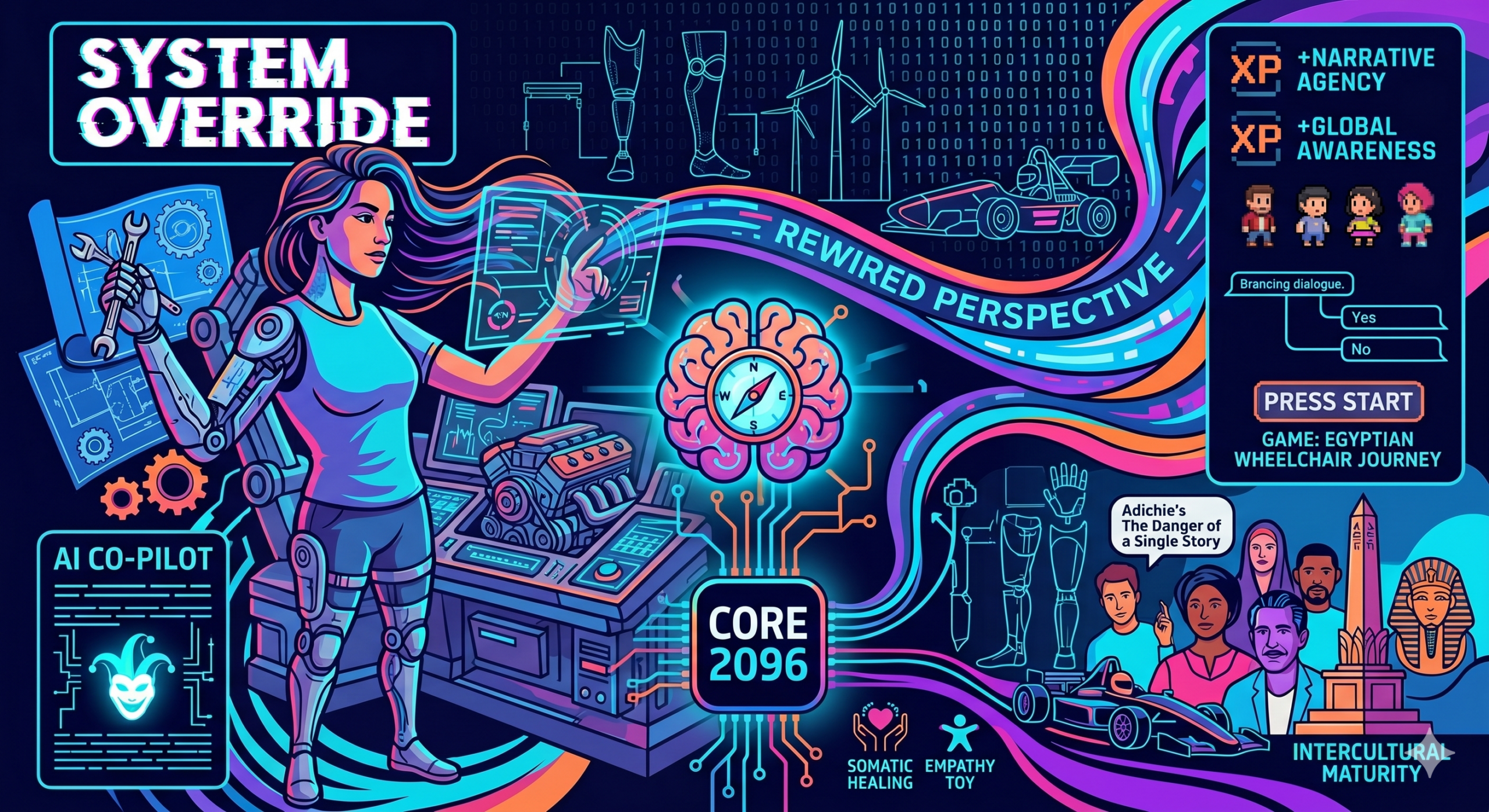
As my creative way of presenting this final reflection, I designed and built an interactive, text-based RPG game that uncovers my entire course experience. I wanted you to step into my shoes, make the same choices I had to make, and see how your logic and empathy stats evolve!
🎮 You can play my CORE 2096 Experience Game here: GAME LINK
Now, let me tell you about the specifics of the most impactful learning experiences I had in this course, and how much it shifted my perspective.
The Impactful Learning Experiences
About Myself Since the start of the semester, I had zero expectations. I didn’t know what this course was about or what we would learn. I just saw that it was AI and digital-related, and since those two are among the most important things in my life and I’m so passionate about them, I thought it would be interesting to join. From the very beginning of the first class, I was amazed by the way Dr. Maha used the smart room. I finally realized why smart rooms were made in the first place!
At first, I was really confused because I was expecting that we would strictly learn about AI. Instead, the beginning of the classes focused on learning about ourselves and different cultures through various games and activities. I didn’t understand what these things had to do with AI and digital literacy. Then, I understood: we have to learn about ourselves to create a game that speaks about us in an informative way, allowing others to learn from it and make use of it. We couldn’t do that without knowing ourselves first. We also learned about cultures and different people’s perspectives using videos, games, and discussions because we were preparing to meet people from around the world using digital platforms, and we had to be ready for that.
Through all of this, I learned about myself that I can adapt socially. I always thought that I’m an introverted person who couldn’t deal with people. But with every activity, the opposite proved true. Usually, I’m one of the most active speakers in any group. I’m usually the one who moderates conversations within the group, like when we’re playing games about our feelings and thoughts. Even when it feels awkward, I put my feelings aside and try to continue with the game. When one of the group members feels stuck and doesn’t know how to answer, I try to redefine the question for them, even when I feel uncomfortable. This actually connects to my experience in the somatic healing session, where I realized my body holds onto unexpressed emotions—like the devastation I felt after adding 13 seconds to my time at the Paralympics. Learning to process these feelings, rather than just pushing past the awkwardness or pain, has been a huge realization for me.
In My Academic Life I learned to respect the system, specifically during the critical AI reflection. I was typing my reflection to the AI in Arabic, having the AI translate it to English, and letting it give me the final format. I didn’t realize that this was incorrect, but when Dr. Maha pointed it out, I thought about it and found that it makes perfect sense. We are in an English-based university, and every person in this university is expected to speak in English. It is genuinely better to think about topics in English because we learned the material in English; the words and context make more sense, so this is the logical thing to do.
In My Social Life Now, I’m much more confident about my ability to interact with people outside my small circle than ever before. Because I interacted with my peers in class activities—none of whom I knew before—and we discussed so many things on a deep level, I never felt disrespected by any of them. I feel that it’s okay to open up. I interacted not only with my classmates but also with people from around the world on the Tahrir trip and in Soliya, and I never regretted speaking my thoughts around them.
In My Career For my professional future, I really appreciate the interview I had with Ahmed, Rokaya’s brother. We spoke for almost an hour and a half. He told me about everything related to his career since he graduated with a mechanical engineering degree from a Malaysian university. He was so generous, and I was really inspired by his career path. I’m now seriously considering working in consultancy, just like he does. Between his insights and my discussions with Dr. Arafa about using AI as an engineering co-pilot, I feel much more prepared for the professional world.
The Portfolio: Evidence of My Learning
If I were to show someone my learning in this course, I would use these three things that I created, because they perfectly encapsulate my journey:
- [My ALTCV (Posted on Instagram)] Why: I posted my CV on Instagram because I really liked and enjoyed working on it, and everyone I show it to likes it. I felt it beautifully summed up all the things I’m interested in, so I posted it for everyone to see.
- [An Egyptian Wheelchair User’s Journey (Interactive Twine Game)] Why: Creating this game highlighted my life’s struggles and daily realities as a wheelchair user. It allowed me to share my experiences in a smart, elegant way without falling into pity-seeking narratives.
- [A Reflection That Uncovers Precious Perspectives (Soliya Prep)] Why: I put a lot of personal input into this reflection regarding the team talk. Chimamanda Ngozi Adichie’s “The Danger of a Single Story” really resonated with me, as I constantly fight the assumptions people project onto me.
Iterating on the Course: What I Would Change
If I could change a few things about the course to improve it, I would change these two aspects:
- Restructure Soliya: I appreciate the idea of Soliya, but I didn’t like the experience of having to commit 2 hours every week to conversations that were not always useful. I recommend making it less than five weeks, and perhaps shorter than 2 hours. The Tahrir trip was the same fundamental idea as Soliya, but it was only one time for an hour, and it was way more of an eye-opener for me than the five whole weeks of Soliya.
- Reduce the Startup Class Games: I appreciate the idea behind the startup class games, but for most of the time, it felt awkward. The only real takeaway I got from them was becoming more socially adaptive so that I could handle awkward situations inside the group. I didn’t actually learn anything about myself from the specific game questions. I recommend reducing these games in the future, though I will say I really enjoyed the physical Empathy Toy game!
The Target Audience
In one sentence: What kind of person should take this course? The kind of person who should take this course is one who likes discussing different topics and is curious about people and the world around them.
The Digital Toolbox
Reflecting on the digital tools we learned about, here is my technical review:
- The Smart Classroom (Classroom Technology): I finally know the true use of the smart classroom because of this course. It seems the rest of the university courses don’t know how they should be utilizing it! Dr. Maha’s use of it was amazing.
- Slack: This was a highly interactive tool, and I really liked it for managing communications.
- Zoom: I don’t usually prefer Zoom. I don’t like the interface at all, and I much prefer Google Meet for virtual interactions.
- Google Gemini (AI): Gemini was the “joker” (wildcard) in this course! I learned new things about its capabilities, like how it can make games on Canvas, which was incredibly inspiring for me. (In fact, I used Gemini to help me code the retro RPG game linked at the top of this letter!)
- Quick Draw & WebAIM Contrast Checker: I really liked both of these. WebAIM in particular is highly practical for ensuring design accessibility.
- reflection.creativitycourse.org (WordPress): The class blog was very interesting, and I highly recommend it for all CORE courses.
The Intercultural Experience
Reflecting on the intercultural experiences, the contrast between the virtual and the physical was massive for me. The field trip to the AUC Tahrir campus was incredible; interacting with foreigners in person proved to me that we share the same cultural baseline, consume the same media, and laugh at the same things. During this trip, I spoke with some American girls who were experiencing the real Egypt—visiting local areas like Maadi and Wust el Balad, not just tourist bubbles. It was amazing to hear that they loved Egypt for the exact same reasons we as Egyptians love it: the people and the warm vibes. I really enjoyed seeing my own country and culture appreciated from their outside perspective. It was a one-hour experience that taught me more than weeks of online dialogue.
In contrast, while Soliya had potential, the conversations frequently felt shallow. What would have made it better for me is if we spent less time on the rigid online platform, and instead had more physical, in-person intercultural engagements like the Tahrir trip.
I hope this letter and the game I built give you a clear picture of exactly how much this semester has shaped my logic, my empathy, and my perspective on the world.
Best,
Malak Abdelshafi
AI Disclosure Statement: I used Google Gemini to help organize my raw, original reflections into this structured “letter to a friend” format to meet the final assignment’s creative requirements. I also used Gemini as a coding co-pilot to help me build the HTML/JS for the RPG game linked at the top of this post. Every opinion, personal story, and critique included in this letter and the game is entirely my own original text and thought process. Link to interaction: Link


Provide Feedback