Welcome Back — From a Course I Never Meant to Take… to One I’ll Never Forget
This blog post is a little different. It’s not just an assignment — it’s a reflection on a course that changed the way I think, feel, and learn.
From a Course I Didn’t Choose… to One I’ll Never Forget
I didn’t plan to take this course. I joined it last minute with my friend Hana, just 15 minutes before the drop-and-add period ended. We thought it would be just another elective. But we were wrong.
This course turned out to be one of the most meaningful experiences I’ve had at university. It wasn’t just about assignments or grades. It was about discovering myself, learning to speak up, understanding others, and thinking in new ways. We reflected on identity and empathy, played digital games that made us feel, tested AI tools we never knew existed, and had deep conversations that stayed with us. This course pushed me, supported me, and surprised me.
In this reflection, I’ll share what I learned, what I created, how I changed, and how this course helped me grow — not just as a student, but as a person.
- What were the most impactful learning experiences for me in this course?
About Myself
At the beginning of this course, I was shy, hesitant, and unsure of how I’d fit into a new environment. But something shifted from the very first class — the first 10 minutes. We started with a break-the-ice game, where we stood in two circles facing each other, rotating to meet different classmates. Each time we moved, we had to ask and answer three simple questions: “What’s your name? What’s your major? What’s a fun fact about you?” That one activity changed everything for me. The very first four people I talked to were Razan, Faris, Omar, and Abdelrahman — and just by connecting with them, I felt the ice break and a sense of belonging start to grow. It helped me learn names, break the silence, and feel like I belonged from day one.
Over time, I began letting go of my fear of public speaking. I joined group discussions, participated more, and eventually started speaking in class with confidence. I broke the ice — not just with others, but within myself. By the end of the semester, I didn’t just give a presentation — I designed a small interactive game as part of it to engage the audience. I was no longer afraid to be seen.
One of the first videos we watched in the course was about trauma-informed pedagogy. At the time, I found it interesting — the idea that small actions from educators can help students feel safe, respected, and supported. I didn’t know it would stick with me until much later in the semester.
On the day I was supposed to present my final project, I was mentally and emotionally drained. I showed up, but I wasn’t okay. Without me saying anything, Dr. Maha looked at me with care and simply said, “You can present later when you feel better.” In that moment, I realized I was experiencing exactly what the video had described. I wasn’t just a student completing a task — I was a person being seen. That one sentence reminded me how powerful empathy and flexibility can be in education. It deepened my appreciation for trauma-informed teaching, and it’s something I’ll carry with me in how I treat others, too.
That I Will Use in My Academic Life
One of the most valuable lessons I gained from this course was learning how to critically evaluate and use AI tools in my academic work. Before this, I had never heard of tools like Perplexity, Google NotebookLM, or Gemini, and I felt overwhelmed by their complexity. However, the assignment where I tested these tools—and reflected on my experience (here’s my reflection)—helped me understand important questions: Who built these tools? What data do they use? Are they helping me think or doing the thinking for me?
This process taught me to assess AI tools beyond just their speed or “smartness,” focusing instead on their accuracy, ethical implications, limitations, and real usefulness. It has completely changed the way I approach academic research and writing. Now, I confidently use AI tools like ChatGPT and Poe to support deeper research, brainstorm ideas, and refine my work — but always with awareness and critical thinking. I no longer accept answers blindly.
Thanks to this course, I’ve gained digital literacy that will guide me through all my university studies. I now explore new technologies with both curiosity and caution, a skill that is essential in today’s rapidly evolving academic environment.
That I Will Use in My Social Life
One of the most profound transformations I experienced in this course came through the Soliya Connect Program. Before this, I had never participated in such a diverse and deeply reflective dialogue space. Through Soliya, I connected with people from around the world—Japan, Pakistan, the U.S., Italy, and more. These conversations went far beyond small talk; we discussed values, identity, technology, and social issues.
Initially, I thought a good conversation meant respectfully defending my own opinion. But Soliya taught me that real dialogue is about listening—not just to reply, but to genuinely understand others. I practiced patience, openness, and empathy. I also became aware of my own unconscious biases, something I reflected on deeply in my Pre-Soliya Reflection. This awareness grew even more through my Final Reflection on the Connect Program, where I explored how meaningful dialogue can build bridges across differences.
This shift has transformed how I communicate socially. I now listen more, interrupt less, and stay present even when I disagree. I’ve realized that connection doesn’t come from similarity but from mutual respect and a willingness to engage deeply. This mindset is something I will carry with me for life.
That I Will Use in My Career
The assignment that most clearly shaped my professional thinking was How AI is Transforming Finance. It connected everything I learned in this course to what I experienced in my internship at GASCO. I had seen how much time and energy is spent on manual financial tasks — closing reports, reviewing journal entries, and managing risks. Through my research and interviews with Dr. Jasmin Fouad and Salah, I discovered how AI tools are already reshaping finance: real-time fraud detection, robo-advisors, predictive analytics, and more.
Before this course, I thought finance was about numbers. Now I see it’s about systems, ethics, innovation, and adaptation. This project helped me realize that AI is not a threat — it’s a tool I must learn to work with. It gave me clarity and motivation to develop new skills and stay future-ready.
I no longer see my career path as just a series of tasks—I see it as an evolving space where I can bring creativity, digital intelligence, and empathy into everything I do. You can read more about my reflections and interviews in this published piece on AI and finance.
2. If I were to show someone my learning in this course, I would use these three things that I created because…
1. Ingredients of Malak (Alt-CV) (link)
This assignment was totally different from anything I’d done before in a university class. Instead of focusing on grades, formats, or technical skills, it asked me to really think about who I am. I called it “Ingredients of Malak” because I wanted to show that I’m not just a list of achievements or skills. I’m made up of so many things — my experiences, the cultures I’m part of, my feelings, memories, and the dreams I’m working toward. All these little pieces come together to make me who I am.
Using Canva to create a visual CV was a game-changer. It gave me the freedom to express myself in ways that words on a page never could. I added photos, symbols, and personal statements that reflect my personality and values — things that don’t fit into a traditional resume. This wasn’t just a project; it felt like I was finally telling my own story.
Doing this made me realize something really important: it’s okay to be real and vulnerable, even in school. For the first time, I felt like my story mattered just as much as my grades or skills. I understood that self-representation isn’t just about selling yourself — it’s about owning your identity and being proud of it. That gave me a new kind of confidence. It wasn’t about being perfect anymore; it was about being authentic.
This assignment was the start of a bigger journey for me in this course. It helped me find my voice, and that voice carried through everything else I did — in group talks, presentations, and the final project. I learned that learning isn’t just about taking in information; it’s about understanding and sharing who I am. That’s a lesson I’ll keep with me long after this course is over.
Overall, this assignment shows how this course helped me grow in ways beyond just academics. It enhanced my self-awareness, creativity, and confidence. It taught me to value my own story and express myself honestly. More than that, it helped me find my voice — something that carried through everything I did in the course. This course wasn’t just about learning facts; it was about learning who I am and how to share that with others.
2. The Power of Small Actions Game (link)
This game was honestly one of the biggest turning points for me in this course. It changed how I see creativity, teamwork, empathy, and how learning can actually be used to make something that matters. I worked with my closest friend, Hana, and we based the game on our real Community-Based Learning experience at an orphanage. We didn’t want to just describe what we went through — we wanted others to feel it. That’s how the idea was born: a game that shows how even small decisions during community work can carry real emotional weight.
We started with a simple version on Google Forms, but after getting feedback that it needed more visuals and interaction, we rebuilt it using Poe Pro. At first, I had no idea how to use the platform. I felt overwhelmed and stuck. But that’s when teamwork truly mattered. Ritage and Ali supported me step by step, explaining how everything worked and encouraging me to keep going. That experience showed me how powerful peer learning can be — sometimes your biggest lessons come from classmates, not just the professor.
The final game had two storylines: volunteering at an orphanage or a retirement home. Each one had ten different scenarios, and every decision shaped how the story unfolded. At the end, players got a reflection message based on their choices. It wasn’t about right or wrong — it was about thinking, feeling, and understanding how your actions impact others.
This assignment taught me how storytelling, technology, and empathy can work together to create something meaningful. It also helped me grow from feedback and reminded me that real learning happens when we take risks, work together, and care about what we’re creating.
3. How AI is Transforming Finance (link)
This assignment really brought everything together for me. It connected what I already knew from studying finance, what I saw during my internship at GASCO, and all the new tools and ideas we explored in this course. I used to think of AI as something far off and futuristic, but working on this made me realize it’s already here and it’s already changing how finance works.
To dig deeper, I interviewed Dr. Jasmin Fouad, a finance professor at AUC, and Salah, a financial accountant at GASCO. I wanted to understand how people actually working in the field see AI’s role. They shared so much insight, like how AI can help detect fraud in real time or how robo-advisors are giving people smarter, faster financial advice. What really stuck with me was how AI isn’t just making things faster. It’s helping reduce mistakes, make processes more efficient, and maybe even make finance more fair and accessible. But I also learned about the risks like data privacy, job displacement, and the need for human judgment behind all the tech.
This assignment felt personal. During my internship, I watched the team spend hours on repetitive tasks and getting overwhelmed during closing periods. I remember thinking, “There has to be a better way.” This reflection helped me see that there actually is. AI could make things smoother, not by replacing people, but by helping them do their jobs better. That idea really clicked with me. It even inspired me to start learning more about how AI works, because I now see that if I want to grow in this field, I need to understand both the tools and the responsibility that comes with using them.
Honestly, I’m proud of this assignment. It’s based on real experience, shaped by meaningful conversations, and it helped me connect what I’m learning now to who I want to become in the future.
Final Reflection
If someone outside this course looked at my three assignments — the Alt-CV, the digital game, and the AI reflection — they would see a version of learning that goes way beyond memorizing terms or writing essays. This course wasn’t just about content. It was about exploring who I am, how I think, and how I work with others. Each assignment pushed me to reflect, take creative risks, and tell real stories — whether that was through visuals, gameplay, or interviews.
Through this course, I learned how to express myself more honestly, how to collaborate better, how to deal with challenges especially with new tools, and how to turn personal experience into something meaningful. This course didn’t just teach me new things. It taught me new ways of thinking and new ways of showing up, as both a student and a person.
3. If I could change 2–3 things about the course to improve it, I would change these things…
1. Field Trips Are Essential for This Course
Firstly, I think adding more field trips to the course would make a big difference. Actually visiting places related to what we’re learning—like community centers, nonprofits, or local projects—would help us connect the lessons to real life in a way that reading or classroom discussions can’t. Being there in person, seeing the environment, and meeting people involved would give us a deeper understanding and make the experience more meaningful. It would also boost our teamwork and creativity because we’d have real stories and emotions to inspire us. Overall, field trips would make the course more engaging and help us learn in a richer, more memorable way.
2. Improved structure and guidance during Soliya sessions
One more thing is the Soliya program experience. I was truly excited about the Soliya Connect Program — and overall, it delivered powerful and eye-opening conversations. I got to speak with people from Japan, Italy, Pakistan, and the U.S., and I learned so much from their stories and perspectives. But there were moments when the group discussions felt flat or unbalanced.
Our facilitator, Vlad, was very kind, but sometimes he wasn’t able to guide the conversation effectively. There were long silences, unclear transitions between topics, and a few voices dominating while others stayed quiet. My classmate Farris and I often tried to keep the conversation flowing by jumping in, asking new questions, or summarizing people’s points just to help the group stay connected. That effort helped me grow personally, but I also felt the sessions could’ve gone deeper if we had more structured moderation.
Maybe future groups could benefit from pre-set discussion themes, rotating student moderators, or quick ice-breakers before each session. Having a clearer structure would’ve helped everyone feel safer and more involved, especially in sensitive or complex topics like AI, gender, or global conflict.
3. A formal space for peer feedback and reflection sharing
One of the most valuable parts of this course was the informal feedback I received from classmates — sometimes after presentations, other times in private chats. I remember people reacting warmly to my Alt-CV: Ingredients of Malak, giving comments like “This really feels like you” or “I never thought of using Canva that way.” After playing my game, some classmates told me it made them emotional, and that the retirement home path reminded them of their grandparents.
But these comments were scattered and casual. I wish we had a structured way to collect and give feedback to one another — maybe through Google Forms, anonymous reflection swaps, or comment sections under each published blog post. That kind of structured space would’ve helped us improve, feel seen, and reflect more deeply. It also would have allowed us to learn from each other’s styles, not just our own work.
Feedback is where learning really grows, and in a course so focused on creativity and voice, it felt like a missed opportunity not to have more of it built into the process.
4. In one sentence: What kind of person should take this course?
This course is for anyone who’s ready to explore themselves, challenge their thinking, express their ideas creatively, and connect deeply with others — even if they didn’t think they were “that kind of person” before.
5. Reflecting on the tools we learned about in this course. Which ones did I like, and how might use in the future personally, academically or professionally? Which ones did I not like and why?
1. Leonardo.Ai – Text-to-Image Generator
Leonardo.Ai was one of the most exciting tools we explored. I liked how it allowed me to bring abstract ideas to life through visuals. It helped me visualize emotions, moments, or scenarios that words alone couldn’t fully express. Personally, I’d use this for creative projects like digital storytelling or vision boards. Academically, it would enhance presentations and visual reports. Professionally, I think it has great potential in marketing, advertising, and content creation roles. It sparked a new kind of creativity in me — combining imagination with technology.
2. Reflect Blog Website
At first, I didn’t like using the Reflect blog site because I found it confusing and didn’t really understand how to post or navigate it. But once I figured it out, it became a space where I could truly reflect and express myself in an honest and open way. I liked being able to post entries and look back at how my thinking evolved. I can see myself using similar blog tools in the future for digital portfolios, personal writing, or academic reflection journals. It taught me that even when a tool is frustrating at first, it might still become meaningful over time.
3. Pixabay – Free Stock Image Platform
Pixabay was one of the tools I found incredibly useful and easy to use. I liked how it offered a huge variety of free, high-quality images and videos that I could use in my assignments and presentations. It helped me visually enhance my blog posts and digital game project without worrying about copyright. Personally, I’ll keep using it for creative projects, social media, and even gift ideas like custom cards. Academically, it’s a great resource for visual storytelling, and professionally, it could support content creation in marketing or communications roles. It reminded me that powerful visuals don’t have to come from expensive tools — sometimes the most accessible resources are the most impactful.
4. WebAIM Contrast Checker
This tool opened my eyes to something I had never thought much about — color contrast and accessibility in design. I liked how simple and direct it was. It made me rethink how I use colors in slideshows, documents, and even social media. Personally and academically, I’ll definitely use this tool to make sure my work is readable and inclusive. Professionally, it’s important for any digital communication. It taught me that good design isn’t just about style — it’s about making sure everyone can access and understand the content equally.
5. Color Blindness Simulation (Colour Blind Awareness)
This simulation experience was powerful. I didn’t like what I saw — not because of the tool itself, but because it made me realize how many things I take for granted when it comes to visual design. I now understand that many people see the world differently, and that we need to design with that in mind. This tool made me more empathetic and mindful. I may not use it every day, but I’ll return to it whenever I’m working on something visual, whether it’s a presentation, infographic, or digital platform.
6. Sahehly – Arabic Language Correction Tool
Sahehly is an online platform that provides important features for checking Arabic texts, including full proofreading for spelling, grammar, and syntax. At first, I found it a bit tricky to navigate and wasn’t very comfortable using it. However, I appreciate how useful it is for anyone who writes in Arabic and wants to improve their language accuracy. Personally, I think Sahehly could be very helpful for me in the future when I need to write or edit academic papers, professional emails, or any formal Arabic texts. Although it wasn’t the easiest tool to use at first, I recognize its value for anyone who wants to produce polished, error-free Arabic writing.
All in all, this course introduced me to useful digital tools that improved my creativity and technical skills. While some were easy to use, others took time to learn, but all added value. I now feel more confident using these tools in my academic work and personal projects. This experience taught me to embrace challenges, as they lead to growth and new skills. I look forward to applying what I’ve learned throughout university and in my future career.
COURSE ADVERTISMENT

This is designed through Canva, and the pictures are from Google.
QUICK COURSE JOURNEY
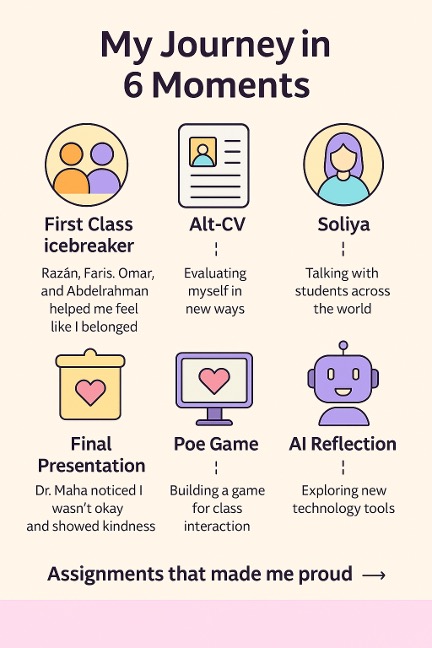
This picture is AI generated
Here is a quick recap of my journey in the course
I did this video through an AI tool called Invideo AI
NOW YOU HAVE REACHED THE END OF MY JOURNEY
Looking back, I never expected this course to have such a lasting impact on me. What started as a last-minute decision turned into one of the most meaningful experiences of my academic journey. It helped me grow not just as a student, but as a person. I learned to slow down, reflect, connect, and truly listen to myself and to others. I’ve come to understand the value of empathy, vulnerability, and the strength in community. This course reminded me that education isn’t just about information; it’s about transformation.
Thank you, Dr. Maha, for creating a space where we felt seen, heard, and valued. Your warmth, support, and sincerity made all the difference. You taught with heart, and that heart shaped every moment of this course. I’m deeply grateful for everything you shared with us and for the way you helped me reconnect with parts of myself I had forgotten. Thank you for believing in us.
I declare that the ideas and content in this work are entirely my own. I have used AI tools solely to help refine the wording, improve grammar, and enhance the overall flow of the text. All original thoughts and concepts remain my personal work.


Provide Feedback