
Hello everyone!
Welcome back to another blog post. Today, I had the opportunity to test out different AI tools so that I can tell you which one is the best! Let’s start:
Perplexity.ai:
So, I wanted to see the results each AI tool will bring to me regarding a topic that it may not be familiar with. I chose the Arab spring, the 2011 Egyptian revolution in particular.
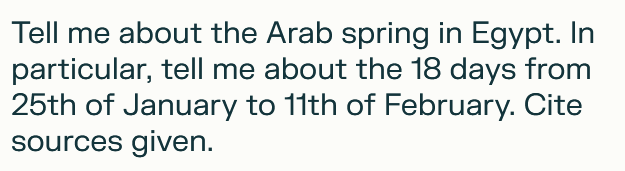
This is an image of the prompt question that I used to ask the AI search engine.
The search gave me a few key events that happened during the 18 days from the start of the revolution to the resignation of Mubarak.
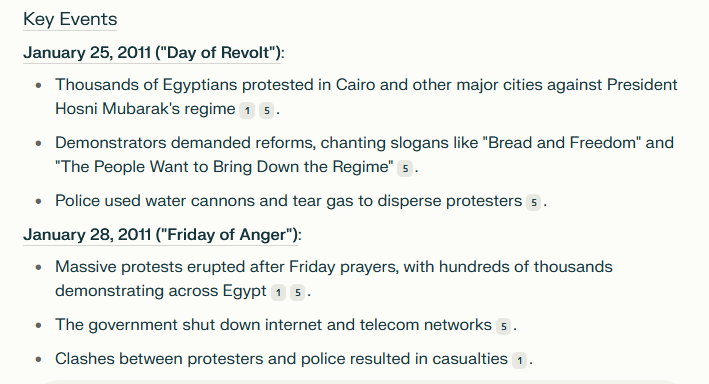
We can see that the AI tool was citing its words, which is a good indication that it is not basing its words on conjecture.
However, most of the sources the AI tool used were popular sources, such as Wikipedia and news sources.
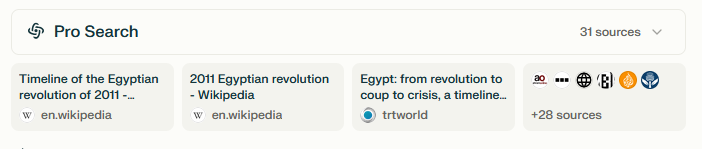
Although it used many sources in its search process, most of the sources are popular sources and cannot really be used for research.
Also, since the sources we see in the image are popular, we would not expect to find these sources on the AUC Library search or Google Scholar, as these search engines provide users with peer-reviewed research, most of the time.
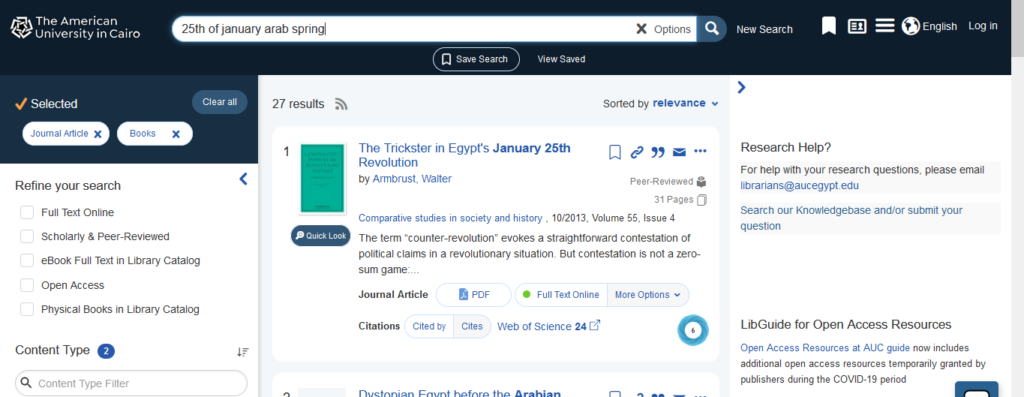
Therefore, my recommendation would be to use Perplexity.ai for getting an idea about something, as its summary about the topic is nice. Despite this, the summary it gives you is not special in any way, as one can find the same information on Wikipedia or by a quick google search. However, if you are someone who does not have that much time, and want to get a quick idea about something, you can use Perplexity.ai. Or, if you would like to find popular sources, such as news articles, Perplexity.ai would be a useful tool.
Overall, I rate it 6.5/10. I would not use it much as I prefer tools that are provide peer-reviewed research.
Consensus:
Before I start, I want to say right off the bat that I really liked this AI tool. It is very organized and provides users with a plethora of sources that are peer-reviewed. I used the same prompt question as I did in Perplexity AI.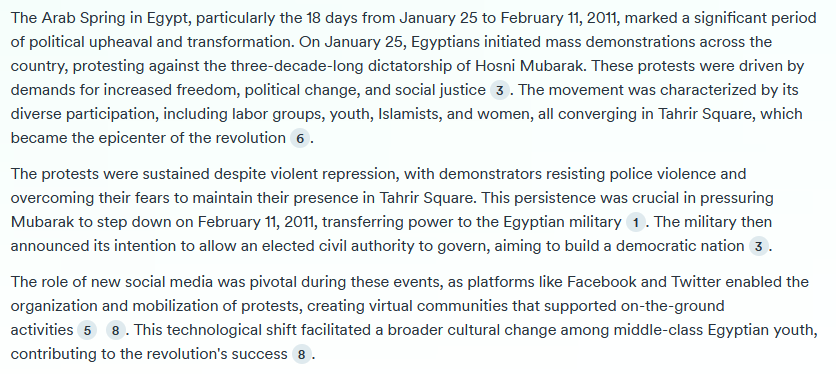
As we can see, Consensus provides with a detailed description of the events, with a lot of citations, which is really good because this means that its words is based on credible sources.
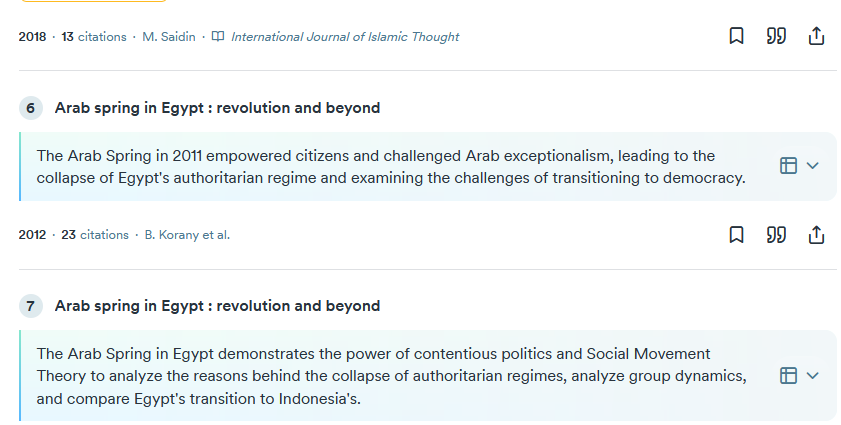
This is an example of some of the sources it cited in the description text. We can see that it provides us with the date, author, and even the number of citations! 
What’s really great is that it even provides users with the SJR score, which is basically a score given to journals (the higher the score, the more prestigious the journal).
Comparing these results from the ones we got from the AUC library search, we do not see any particular search results that are the same, but we can see that both are of similar quality and credibility, although I still think the AUC library search’s sources are better and more credible (higher SJR score).
All in all, I think Consensus is a really great tool that I would use again. I would recommend it to anyone writing a research paper or project. Moreover, the summary it provided me about the topic was on point and detailed. I also like that the information comes from peer-reviewed articles, so at least I know that the information is better than what is on Wikipedia and I can actually use it for research purposes. I rate it 10/10 (yes, I liked it that much ^_^).
Google Notebook:
This tool is different than the other two. Google Notebook requires that you upload sources to it, and then you can ask the AI questions based on the sources that you uploaded. For this prompt, I uploaded a book by Yezid Sayigh, a famous political researcher and analyst, titled “Above the State: The officers’ Republic in Egypt” (Really important piece on the time period).
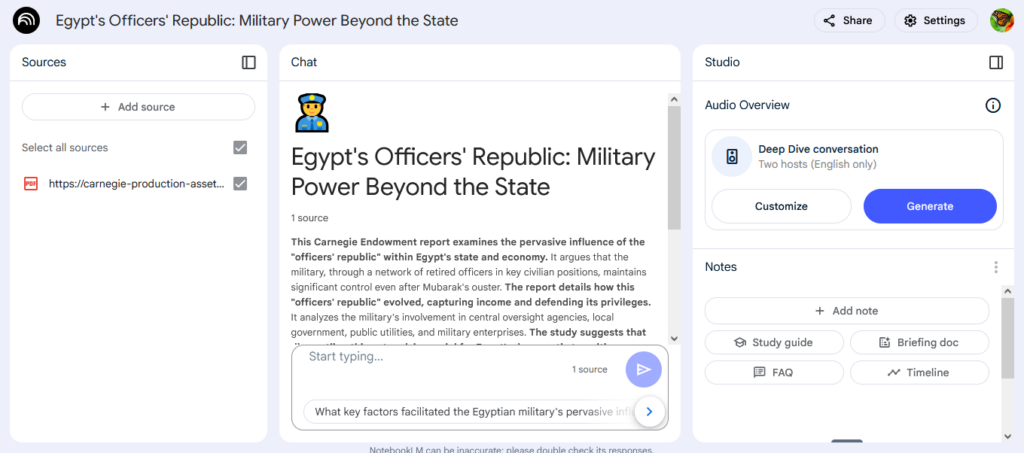
As we can see, it can gave me a rundown of the source (I like the officer icon it included at the top, lol).
I asked it a different prompt question this time “Can you tell me what was the SCAF’s influence on the revolution in 2011”
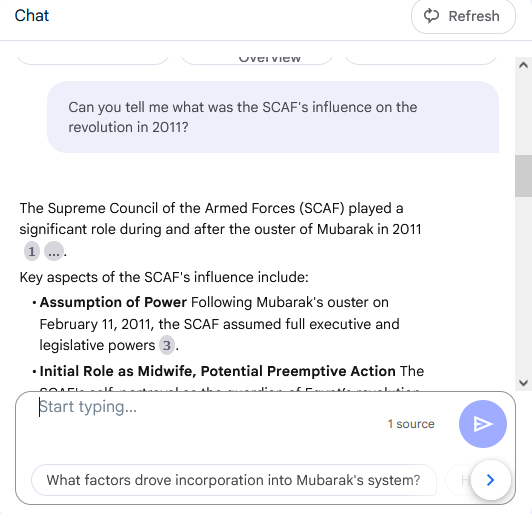
As we can see, it provided us with key points of the SCAF’s influence. Also, it cited its words.
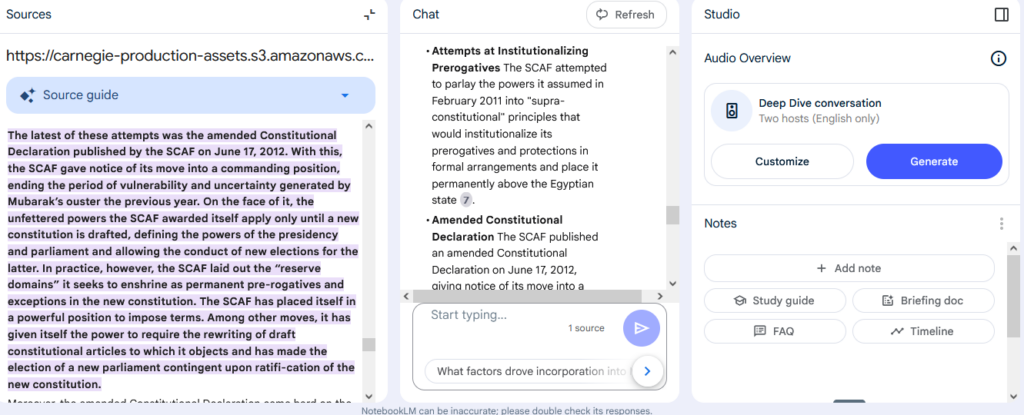
When I went to the citations, it showed me exactly where in the book it got its information from, which is a great option to use if you want to look for information quickly in sources.
I cannot really compare this source to AUC library search as Google Notebook is more of a summarizing tool than a source search engine. Yet, although the tool’s scope is narrow, I think that it does the summarizing part really great, better than the other two tools. It can be both detailed and concise, and I like the idea of you choosing the source, which gives the user the freedom to use whatever sources they want , unlike the other AI tools that provided us with the sources it determined were fit for the topic.
Overall, I rate Google Notebook 10/10 and I would definitely be using it again!
ChatGPT:
For ChatGPT, I search for the prompt question in the image below.
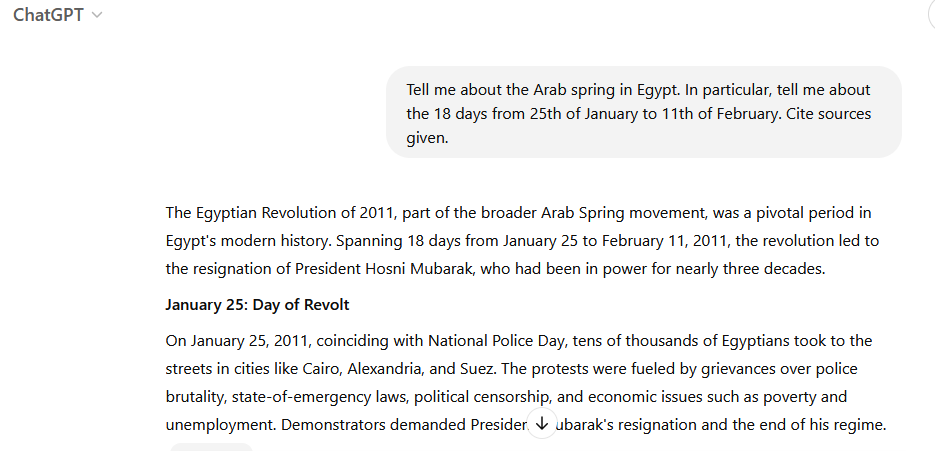
I think we can already see how worse in quality, compared to the other tools, ChatGPT is. For example, we do not see any citations and the summary is very generic and not insightful.
One interesting thing I noted though, is that Perplexity and ChatGPT seemed to skip all the events of the revolution between February 2nd to February 11th and only focused on the main events that happened on February 2nd, the battle of the Camel, and February 11th, the origination of Mubarak.
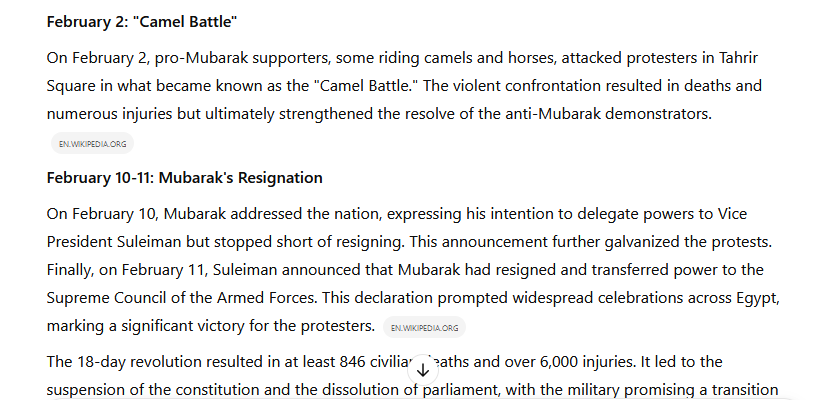
I think this makes sense because if we look closely we’ll see that ChatGPT’s citing Wikipedia, which means that it probably is not basing its information on credible or detailed sources This explains the gaps in its knowledge. But why does Perplexity skip these days of the revolution? Does it have a preference to base its information on Wikipedia as well more than other popular news sources? Perhaps. Nonetheless, I would say that ChatGPT’s summary of the event is bad and missing a lot of key nuances and information.
Of course, ChatGPT would lose against AUC library search, because the sources provided by AUC library search are just 1000 times better and credible.
Overall, I would not recommend ChatGPT’s search or summary function as they are inefficient and not really useful, especially provided that we can have other tools such as Consensus, Perplexity, and Google Notebook. I rate ChatGPT 5/10 (I use it sometimes for assignments).
That’s all for today’s blog folks! I hope you enjoyed it and leave me a comment down below with your most, or least, favorite AI tool. All feedback is appreciated!
See you guys in another blog, stay tuned!
Header image credit: Credit


really interesting – I have a theory on why the AI tools skip over the details in 2011 and focus more on key events like battle of the Camel and Mubarak’s resignation. Worth discussing in class inshallah