Part 1:
1)Spent https://playspent.org/html/
Honestly, this game was very stressing. The game puts you in the shoes of someone living on minimum wage for one month, and from my very first choice, I felt that I was constantly reacting to problems rather than planning ahead. it felt overwhelming, but also incredibly real. Making hard decisions, like whether to pay for medicine or skip a bill was stressful and I found myself thinking what I would do in a similar situation in real life. I found myself putting my personal needs aside to save money for my child for example and I realised that my parents similarly do the same thing with me. Maybe not money wise, but in everything in life they put me first. I was shocked to find out I had 245 dollars remaining, but apparently I’m a good saver!
I felt that the game gave an authentic experience of what living in poverty is like and how heartbreaking it is. It made me appreciate what I have more and even appreciate the things that may seem little to me, but to other people is a big deal because they don’t have easy or constant access to it. What I like most about spent is its honesty. It doesn’t sugarcoat poverty or make it dramatic. it just shows how ordinary problems can become a crisis. That made me more empathetic, especially toward people who face these realties everyday. There are actually people have to make a decision between going to the dentist and paying their bills, which is completely unfair. Also, the game has simple design, which makes you focus more on the decisions rather than on the graphics. I feel like this helped in making us feel the weight of the problem and the message behind the game more.
I think they should add more realistic examples and realistic prices. Maybe because the prices are American I’m less oriented to them, but I still think it can be more realistic. Also, they should add more things needed in the super market, as they ignored a lot of the daily necessities, which also affects spending decisions.
2)Syrian Refugee https://www.bbc.com/news/world-middle-east-32057601
This was another emotionally intense game. I played it twice and I failed one time then completely chose other options so I arrived to safety. I had to leave a mother and child begin to actually reach the refugee camp, which I sadly the truth for many Syrians escaping their home country. This is quite different from spent. Instead of worrying mostly about money, I was constantly considering danger and safety. At one point I drowned and in the other I reached Turkey, but I was stranded. Playing the game twice made me realise how unpredictable the outcomes can be and how dangerous it is for people who has to go through the same journey to escape.
The thing I like the most about the settings of the game is the narrative pacing. It let the story unfold without being dramatic or exaggerated, yet still exposed the hard truth Syrian refugees have to bear. The game made me feel immersed in someone else reality, and like the spent game, it made me feel gratitude toward the simple blessings I have, or the things that may seem simple for me, but are actually hard to reach for others. I walked away from this game with a deeper understanding of how refugees have to constantly weigh risk and hope in order to survive.
A possible improvement could be adding more detail about what happens after reaching safety, such as challenges dating to a new culture or finding stability, as this is a reality that was abstracted from the game. However, the focus on the journey itself was powerful and served its purpose well.
3)Voter suppression trial https://www.nytimes.com/interactive/2016/11/01/opinion/voting-suppression-videogame.html
I played one round as a Latina nurse from Texas. While the character was approaching the voting line, she was informed that her child was sick at school. Next, she was presented with a choice to either pick up her son from school or stay in line to cast her vote. I chose for the character to pick up her son. Furthermore, there was emphasis on the GOP’s tactics to deliberately create long voting lines. I do not support either party, but I found that the information was biased towards the GOP, and it did not create an unfair advantage for one party, as voters from both sides would be forced to abstain. I also found the choice of gender and race irrelevant. I believe the choice would have been the same if the character were a white male supporting the GOP under the same circumstances and presented with the same dilemma. I liked that the game educated me on the issues discouraging voters from casting their votes. Especially that there is no paid time off to vote. However, I disliked the bias of blaming a specific party for this issue.
4)Covid 19 https://h5p.org/branching-scenario
Skills practice: A home visit
My character in the game was a community nurse that is visiting a lady (Irene) on an arranged appointment. The appointment was first arranged based on a recommendation from the nurse caring for her child after a surgery in the hospital, when the nurse noticed signs of concerning stress on Irene. When Irene was presented with the option of a community nurse she made an appointment and that’s when the game began.
I played as the community nurse checking on Irene’s welfare. Where the game seemed to be designed as a training for community nurses on how to conduct themselves during a client meeting and deal with various situations. The first video was quite interesting because a third party ( Irene’s boyfriend) was introduced suddenly in an unexpected way, and responding to such a sudden situation would require quick thinking and reacting to deescalate the situation with the hostile boyfriend and Irene’s abuser. The game taught me in this instance that the most important thing is to prioritize my safety and then try to help the client.
In another instance the answers I had to pick of was not clear enough and despite thinking I’m making the right choice when my character started relaying my answer in their own words it was not what I meant with my choice, so I believe clarity in the provided choices is required to avoid frustrating the trainee.
All in all it seemed like a very informative way to train someone on how to respond and deal with the clients.
5) Domestic Violence in Egypt https://docs.google.com/forms/d/e/1FAIpQLScyWGr3tk8-K8KwH4Mayw6Iblia9ep4TUnAcpwCT_D_WXnnQg/viewform
This game gives detailed, realistic examples that demonstrate how abuse happens. It also highlights how normalized abuse is in Egypt and how society discourages leaving the husband e.g the victim’s parents and police officer.
The game also shows it’s a cycle and why a lot of partners stay like in the introduction giving a crucial disclaimer that the character is financially dependent on him as seen with most Egyptian women.
Finally I liked how after you answer every question there’s a small paragraph explaining the more ethical choice or gives statistics related to the questions. I think maybe they could’ve added more options to choose from.
6) lost a parent https://docs.google.com/forms/d/e/1FAIpQLScff3zm_c_vwAc5Blgb9rpV2CQIoMrr6kUVqESA-E-MM7KEGw/viewform
This is kind of emotional for me because my father passed away, but I was curious to play the game and compare it to my real life experience. This game is actually very similar to what happened to me. My brothers live abroad and my father was diagnosed with cancer. He suddenly passed away during my final exams and one of brothers couldn’t make it back in time for his burial. We were all devastated and my brother was with us the whole time through video calls. I remember I had to sit for my final exam 3 days after he passed away and I actually made it through. That was a business A-level exam in high school. I got an A* and was awarded the highest mark in Egypt for business AL. I’m proud of myself and I really wanted to share this story. I found I out I’m much stronger than I actually think I am. Actually my family and I are very close, so we were the complete opposite of the game. We would always express our emotions and we weren’t hesitant about it. I also had to make a decision whether to study abroad or stay in Egypt like the game. Despite getting accepted at the university of Manchester with a partial scholarship, I decided to stay in Egypt with mum, so that I wouldn’t leave her alone. Like the game I wouldn’t really talk about my father, but as time passed I found the beauty in remembrance. I realized that I was proud of him and wanted to share the beautiful memories we had together with everybody, so that people also know that he was a great man.
I love this game! I think it replicates the truth very much and it reminded me of how staying connected to my family is important.
7) cloud 4
This game was my favorite out of all. I liked the idea that we all sat on the floor, as I really enjoy board games and this is how my family and I play them. It kind of felt familiar and friendly. I enjoyed learning more about my classmates hobbies/ what they like and dislike. I dealt comfortable expressing my emotions as everyone was kind and willing to listen. It felt good knowing that other people experience the same things and have the same views. Some of my classmates even had the same dislikes as me. We also talked about things that made nervous in different contexts and it turned out that everyone is related by thought in on way or another. Also, I learned new vocabulary for emotions. For example the word “happy” had different synonyms in the game and when I looked them up, it showed that there are different levels of happiness and different ways of comprehending and expressing it. This was definitely a new experience that made me understand myself more.
Comparison:
The games kind of showed me that although they all aim to make us feel empathy and awareness, they do so in very different ways. Spent and the BBC’s Syrian refugee experience impacted me the most emotionally because I constantly felt pressure making decisions about money and safe options, which made me appreciate my own stability and understand how exhausting it is for people to live in constant fear and always try to survive. It is also very hurtful that I can’t do much for them. The voter suppression trial felt more analytical. It showed how identity shapes personal experience, while the COVID-19 home visit and the domestic violence in Egypt simulation mostly focused on responsibility and ethical decision making by considering sensitive and cultural contexts. Lost a parent was the most personal, as it reflected my own experience of losing my father and reminded me of my resilience and closeness to my family. In contrast, cloud 4 felt comforting and real because it encouraged open emotional expression with classmates. Overall, I think all the games carried an important message, but almost all of them were stressful and I think this is why they successfully delivered the message. Also, they spread awareness by making us feel personal pain or as if we were the person in the game. I think these games helped me reflect more deeply on different levels and different aspects of my life. Honestly, some of them were mentally draining, but I really admire the experience.
1) The Ikigai diagram:
what do I love?
my family/friends/tennis/my mommy/acting/travelling/spending time with loved ones
what are you good at?
strategic thinking/ socializing and social skills/ emotional awareness/ emotional intelligence/ reading the room
what can you be paid for?
I do great analytical models for economics related subjects
what does the world need?
empathy/equality/innovation/love
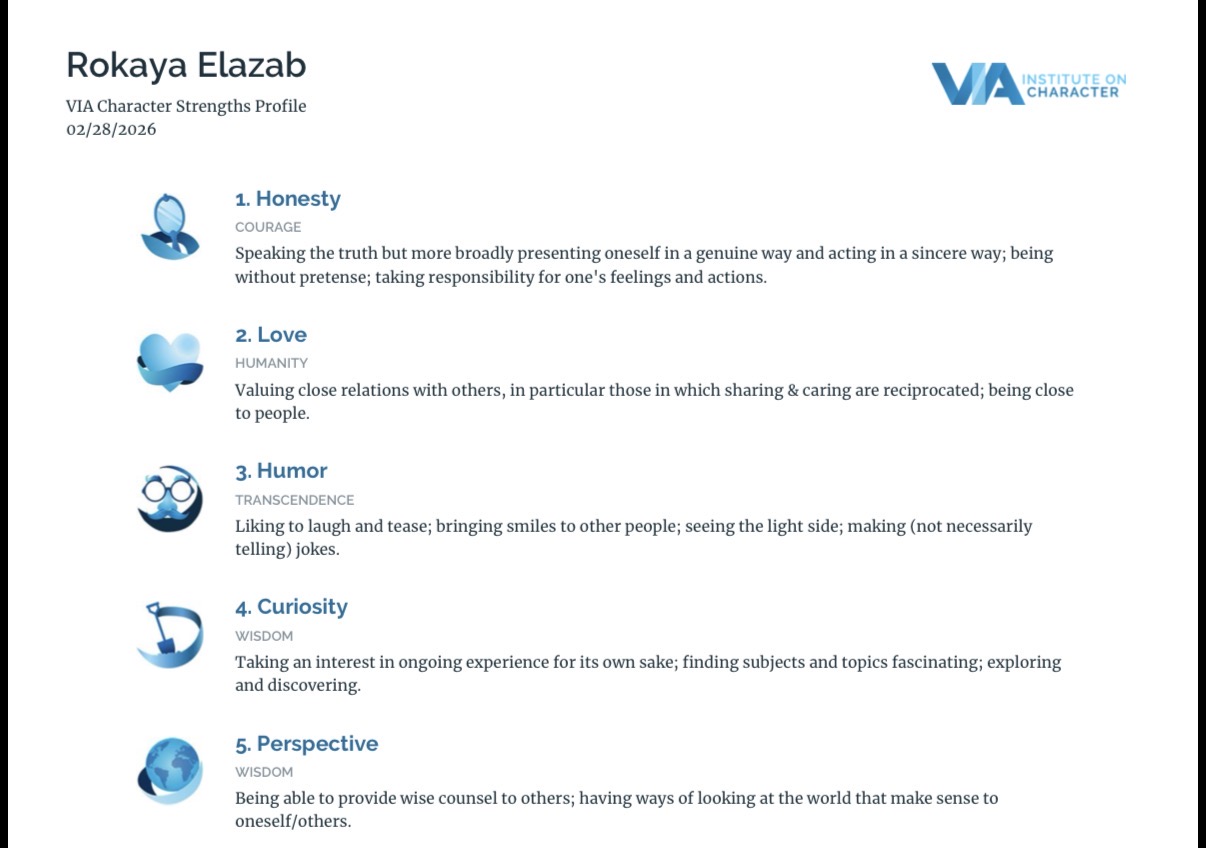
2) The VIA character strengths Survey
1)honesty
2)love
3)humor
4)curiosity
5)perspective
Ai’s ideas for narrative games:
https://www.perplexity.ai/search/1-the-ikigai-diagram-what-do-i-LE1.zfvnRiulZP.LAOuptA
Reflection:
I think it’s very smart that it used my top personality traits to create the game. If someone were to play the game it would be as if they are playing through me. It would be so fun to see how other people choose things differently if they were in my place. The idea of dividing each of my own personality traits into an island/festival/village make people live through real depiction of the world, and see how can they interact and make decisions through very emotion. This can make them know more about their emotions and give them a laugh when shared with friends. Giving them quests in the game is really cool and makes it feel old a video game, but it’s real goal is to put you on a quest of self discovery and authentic living.The game gives you a sense of having a purposeful and balanced life. I don’t think there is something I dislike about the game.
My own idea:
This Ai’s idea inspired me. If I were to make my own game I would make the main character a tennis player walking through a professional athlete’s journey. He/she would be able to live through the athlete’s life and see what it’s like to disciplined like a tennis a player. For example think about food options/ training times/ eating habits/ nutrition. They would also be able to experience the emotional aspect. For example stress/emotional turmoil/ happiness/ victory and all other things professional athletes experience. The goal is to make the player see how can passion for something such as tennis turn into a hug a success and a career if you’re disciplined enough. It would also show how hard the journey is and inspire people to want to go through similar journeys to achieve success. If the player chooses the wrong options in the game he would lose the match/ or quit the sport due to injuries etc. This would help the player learn about the right techniques/disciplines to achieve success.


Provide Feedback