As a psychology student I think AI usage would differ depending on the profession, so if I’m going to talk about the job I want to do which is being a psychologist, it’s very hard to imagine how useful it can be. I will mainly be directly working with patients, so of course I won’t use it during the session or pull it up while they’re talking and expressing themselves. I would assume that if I did use it, it would be for helping me study since I will always need to be studying and updating my information. It can also help me organize my schedule and ideas. I can’t ask it to help me analyze anyone, but it could help me gather the information I want regarding what I’m suspecting, for example. So basically, I don’t think it can help me as a psychologist with anything other than helping me pursue studying. Just like how I use it today as a regular psychology student, I don’t use it for research papers but it helps me self study and to understand complex concepts that I find hard to understand in class.
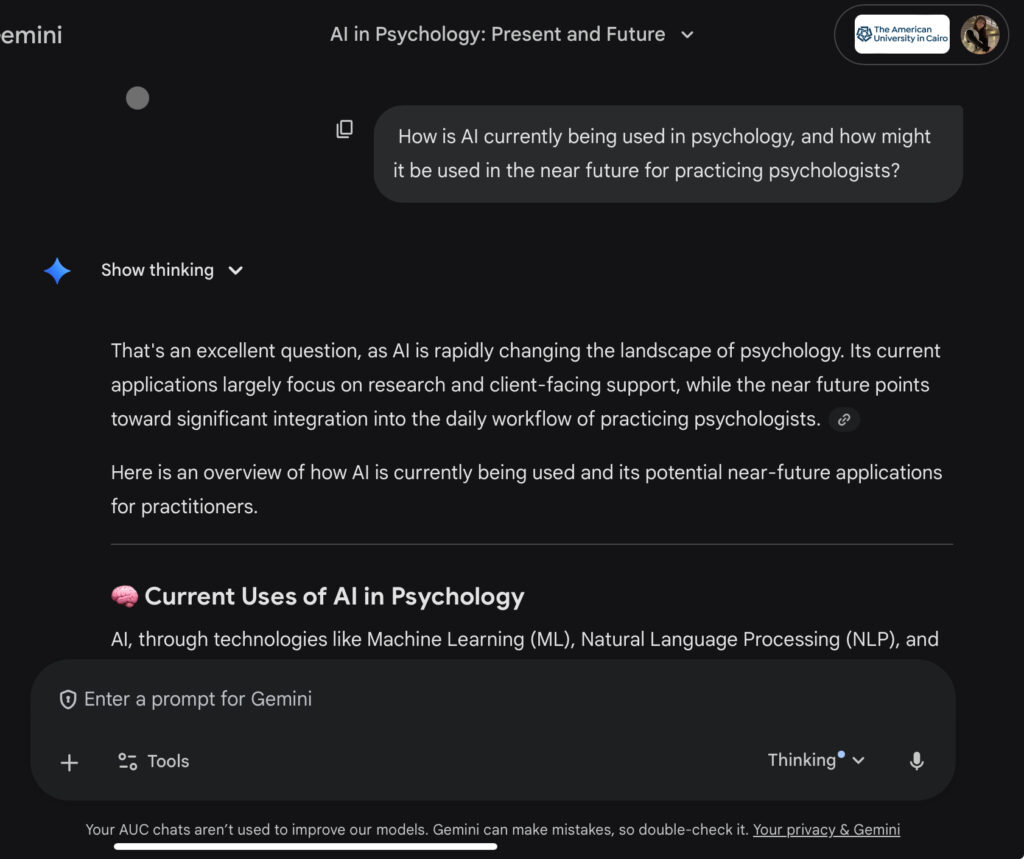
I asked Gemini “How is AI currently being used in psychology, and how might it be used in the near future for practicing psychologists?”
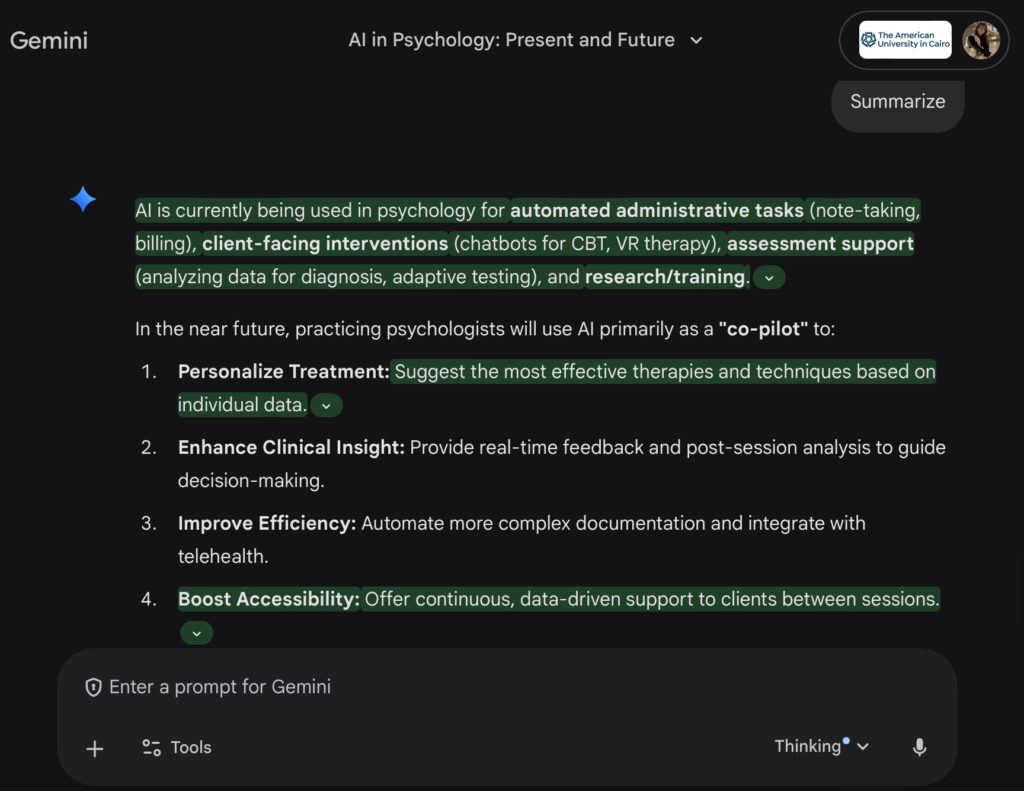
That was its answer:
AI is currently being used in psychology for automated administrative tasks (note-taking, billing), client-facing interventions (chatbots for CBT, VR therapy), assessment support (analyzing data for diagnosis, adaptive testing), and research/training.
In the near future, practicing psychologists will use AI primarily as a “co-pilot” to:
1. Personalize Treatment: Suggest the most effective therapies and techniques based on individual data.
2. Enhance Clinical Insight: Provide real-time feedback and post-session analysis to guide decision-making.
3. Improve Efficiency: Automate more complex documentation and integrate with telehealth.
4. Boost Accessibility: Offer continuous, data-driven support to clients between sessions.
Then I interviewed my professor Dr. Reem Deif who teaches course cognitive psychology and who is a therapist, about how AI is currently used academically and professionally in psychology. She explained that faculty members use AI mainly for suggesting activities for inclass activities and asking for feedback on assignments and syllabus if something is unclear and need to be clarified. She said they do not use it for grading students. She also mentioned that AI can be especially useful in psychology education more than other majors by simulating conversations or experimental prompts because sometimes virtual labs are unavailable.
Regarding professional practice, she explained that AI is not used directly in therapy sessions and is unlikely to replace therapists, since therapy depends heavily on human connection, patience and the therapeutic process. She also mentioned that still AI is useful since it is being developed to help psychologists with administrative tasks like writing session notes, organizing documentation, scheduling appointments and managing records through secure HIPAA-compliant tools. She also said that a problem ai cause for clients is that they depend on it between session as it can promote immediate gratification and sometimes provide advice that clashes with the therapeutic process, since it fails to account for individual differences, cultural context and the complexity of real-life psychological cases.
In the end the Dr. Said that she doesn’t think an could replace therapists since people who go to therapy desire human connection which something ai will always lack.
Below is the transcript of the interview
Haya: Okay, from your perspective, how is AI currently being used in psychology academically here at AUC?
Professor: Okay. Are you asking about students or faculty?
Haya: From faculty, psychology specifically.
Professor: Okay, so this is interesting. I do use AI. For example, I use it to suggest demonstrations or activities that I can do in class. I also use it for feedback, such as on my syllabus and some of my assignments. This is actually very helpful.
When I’m submitting or designing an assignment, most of the time I upload it to AI tools like Gemini or Claude and I ask for feedback such as what guidelines might be missing, whether I should highlight deadlines more clearly or clarify certain parts. AI gives very good critical feedback, ideas for improving assignments and even suggestions for bonus or extra credit. So yes, we definitely use it. However, I cannot use AI when it comes to grading. But when it comes to designing assignments, it is actually very helpful.
Haya: Do you think it’s different using AI in psychology compared to other majors? Is it used or avoided in specific ways?
Professor: I think you can use it even more in psychology. For example, this semester we don’t have access to the online virtual lab. In many instances, you can use a conversation with AI as a prompt for an actual experiment. You can ask AI to examine you or test you on a certain concept and it becomes like an assessment interaction.
So I think it’s very relevant to our subject. Compared to majors like engineering or economics. I’m not sure if their use is more about retrieving facts, statistics, or information, or about designing activities. Computer science, for example, definitely uses it more than we do for coding and technical tasks.
Haya: Moving to the professional world do you see AI being used today by psychologists or therapists?
Professor: I don’t use it in therapy and I doubt that therapists use it directly in practice. However, I often hear clients say that between sessions they had a problem and decided to talk to AI about it. For example, a client had a fight with her boyfriend and decided to talk to Gemini about it.
One important development is that AI tools are being designed to help therapists with note-taking after sessions. These are HIPAA-compliant programs that can take session material and generate structured notes such as the date, presenting problem, techniques used and session goals.
So AI is being used or at least designed, to help with documentation, organization, scheduling, and note-taking, but not with doing therapy itself or applying therapeutic techniques.
Haya: Do you think AI helps psychology students understand complex theories?
Professor: My issue is not whether students use AI. I’m never concerned about that. This is modern science. The issue is how you use it. Are you copying and pasting what AI gives you, or are you challenging it and using it to think critically and expand your knowledge?
If you’re using AI ethically and acknowledging it, and using it to grow intellectually, that’s absolutely fine. In ten years, everyone will be using AI. The goal now is to teach people how to use it ethically and responsibly, not to ban it.
Haya: Do you think AI provides accurate information in psychology, or can it be misleading?
Professor: Psychology is not one-size-fits-all. There are individual differences, cultural sensitivities and many exceptions. AI can give general information, but it cannot guarantee accuracy in every case.
For example, if you ask AI about depression it will give you general trends. But it won’t capture the experience of a very specific individual such as an unmarried person living in rural Egypt. These contextual and cultural details matter a lot in real-life clinical practice.
Haya: Do you think clients using AI can affect the therapist–client relationship?
Professor: Yes, sometimes in sessions we reach a conclusion together and then the client comes back with advice from AI that completely contradicts what we processed in therapy. This creates a clash between the therapeutic process and what the client receives immediately from AI.
Therapy is a process. It’s about delayed gratification taking small steps over time to reach a goal. AI offers immediate answers, which feeds into immediate gratification. This can prevent people from being patient, processing emotions deeply and allowing time for healing. It can also lead to misinformation and oversimplified solutions.
Haya: Do you think AI could ever replace human therapists?
Professor: Personally, I don’t think so. A big part of why people go to therapy is their desire for human connection. They want another human being to truly know their story.
AI might help with things like suggesting coping strategies, skills training, assertiveness skills, or anger management techniques. But therapy is about people coming in, talking about their lives, and processing experiences together. I don’t believe AI will ever replace human therapists. It may support skills training, but not the core therapeutic process.
My reflection :
I didn’t expect that professors take feedback from AI, but it made sense because as students we do the same to make sure we didn’t miss any points. I was also surprised by the professor’s opinion that AI can be more relevant to psychology than other majors. I first thought it wouldn’t be since psychology is a very sensitive field, so I didn’t expect AI to be viewed as useful. However, her explanation that AI could act as an alternative to virtual labs when they are not available made sense.I remember that we actually used AI before as a small test in class and it was useful and did its job. I wasn’t surprised that AI is used behind the scenes in therapy for note-taking and organizing documents but I was surprised when she mentioned HIPAA-compliant programs and the level of security involved. Knowing that there are tools specifically designed to protect client privacy made the use of AI in this area feel more thoughtful and responsible. One part that made me worried is that some clients might rely on and trust AI more than their therapist, which could make their case worse and cause them to lose trust in psychology in general. As the professor mentioned, AI does not take into account all individual differences or different personal and cultural contexts, which are essential in psychological work.
Personally after this interview and after reading more about AI in my field, I am more motivated to work in the psychology field. I now understand that even though AI has its disadvantages, it will never replace therapists. If anything, I see it as a helpful tool that can save time for me and allow me to focus more on my clients.


1 Pingback