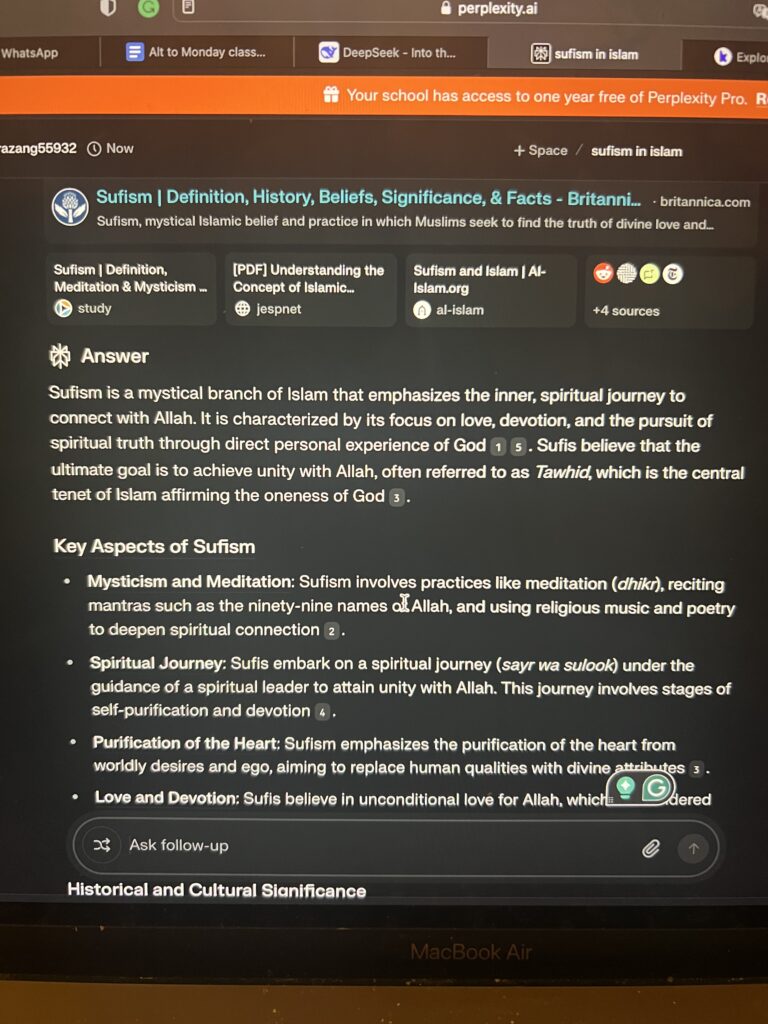
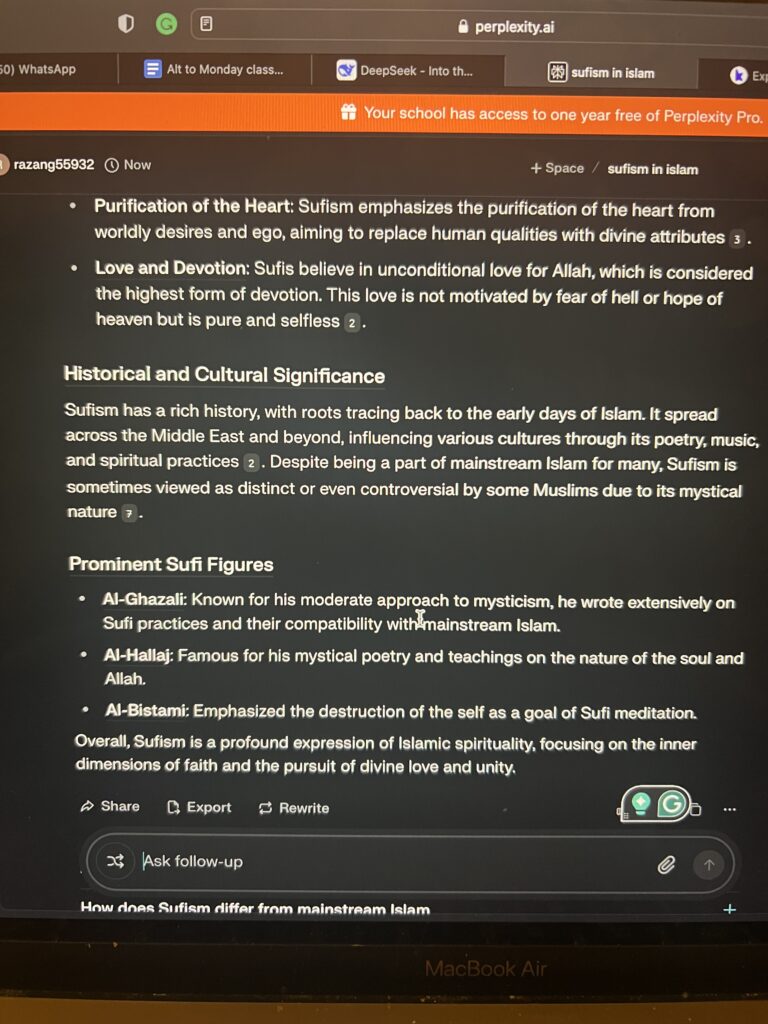
I started with Perplexity.ai, the first suggested tool for this task. I searched for Sufism in Islam. The responses were concise, understandable, and well-structured, backed by quotes from sources like Britannica. Perplexity provided a decent general introduction to Sufism as a mystical element of Islam focused on achieving closeness to Allah through devotion and love. It made strong points regarding dhik and, the path to spirituality, and the requirement of purifying the heart. It also used popular Sufi figures like Al-Ghazali and Al-Hallaj. The information was credible and easy to understand, but it struck me as generic and lacking deeper analysis and solid examples of Sufi activities. For instance, it did not explain how dhikr is performed or have Sufi poetry samples. Overall, Perplexity.ai was simple to use and great for quick research but it left me wanting more content.
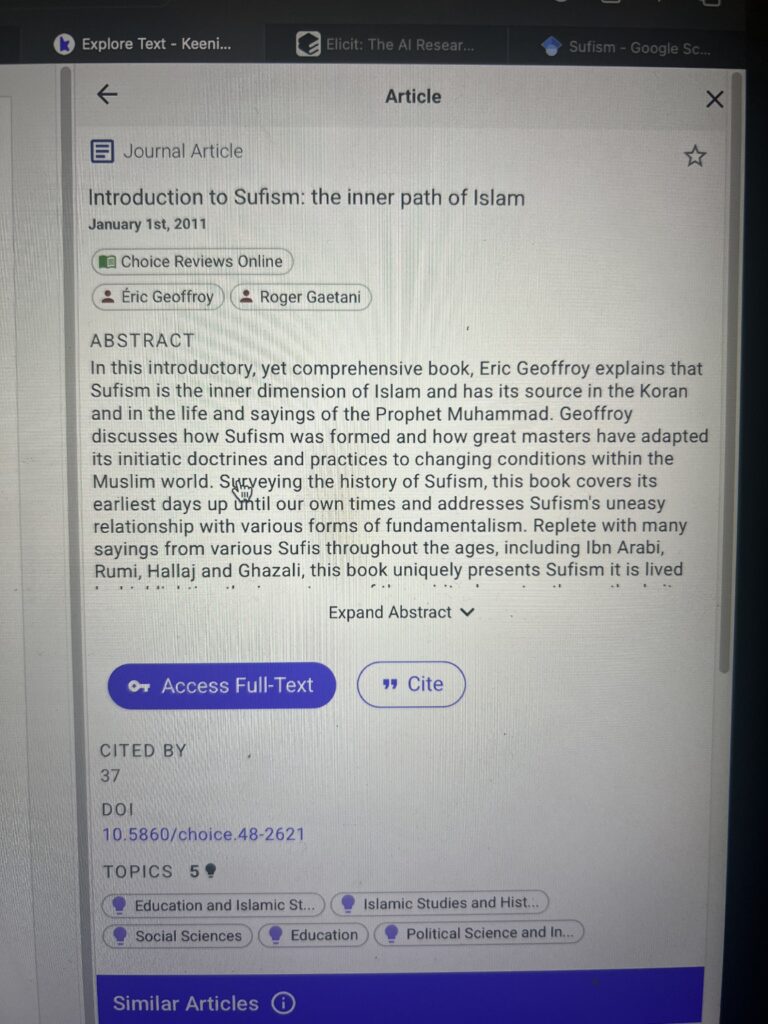
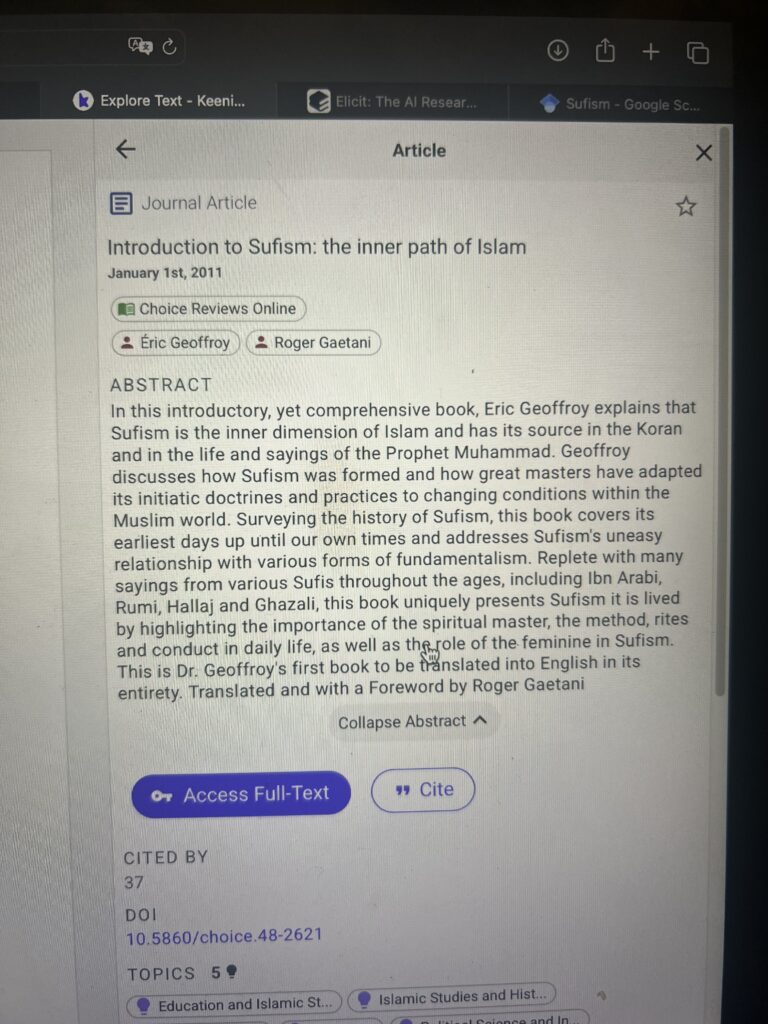
Second, I tried Keenious, and it gave me a more abstract and historical understanding of Sufism. Its results focused on where Sufism originated from and how Sufism has its foundation based on the Quran and the Prophet Muhammad’s message. Keenious discussed the development of practices of Sufi masters and the importance of spirituality in everyday life. It even mentioned some of the prominent Sufi figures like Rumi and Ibn Arabi. One unique aspect was that it spoke to the role of women in Sufism. The answer was less coherent and harder to read than Perplexity.ai’s, however. It did not include specific examples and summaries of Sufi traditions, so it was less readable for someone new to the topic. While Keenious offered helpful background, I found myself struggling to connect theoretical ideas to concrete instances of Sufi life.
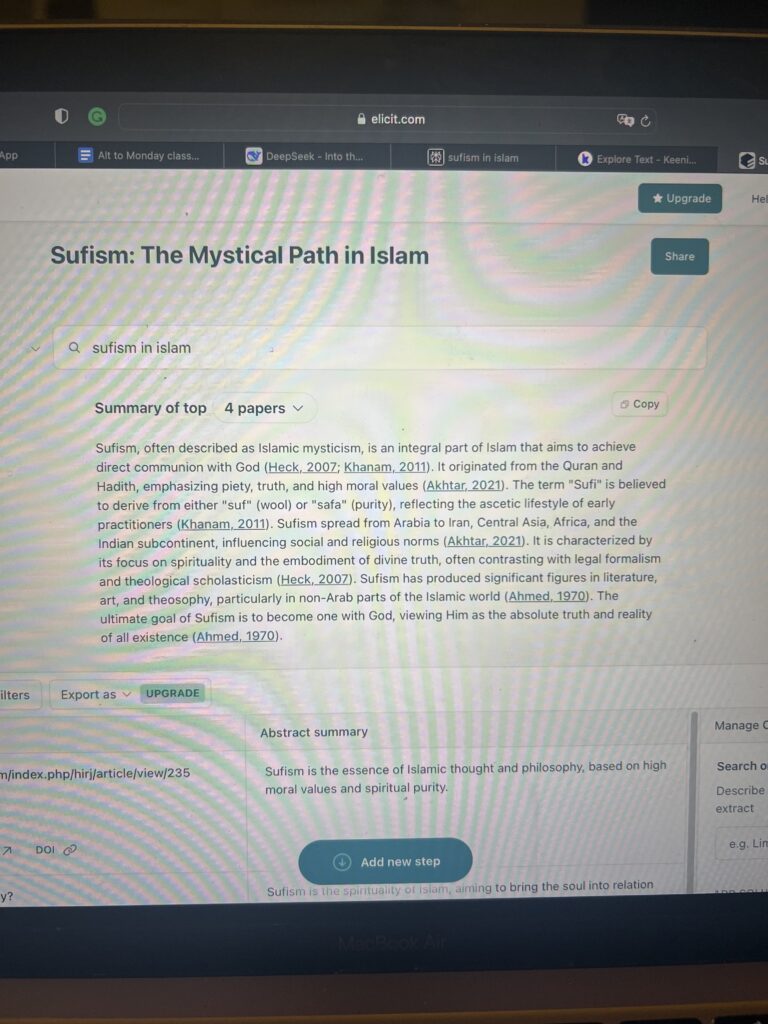
Finally, I used Elicit, which provided me with a more academic perspective of Sufism. The tool combined various scholarly articles, so the data is highly credible but also more technical. Elicit informed me that Sufism aims at direct communication with God and evolved from the Quran and Hadith. It discussed the diffusion of Sufism across areas like Central Asia and Africa and its influence on literature and art. The response also highlighted the religious objective of being one with God. However, the academic tone made it less readable to the masses. For example, it did not describe Sufi practices in a manner that was easy to understand, and it.
Having used all three tools, I compared the results to those on Google Scholar and library search. They were consistent in terms of the underlying Sufist concepts of being religious, being loving, and being faithful. There were variations in how to present the information, with Perplexity.ai presenting general information, Keenious providing contextual information drawn from history and culture, and Elicit presenting to us an academic position. Whereas Perplexity.ai and Elicit relied on credible sources, Elicit’s academic tone was harder to understand. Keenious provided insider knowledge but lacked coherence. I found that all the tools supported each other but none of them on their own gave a complete picture.
I also experimented with each tool’s functionality to see how it might be effective for my research. For Perplexity.ai, I used the ask a follow-up question function to discover more about Sufi practices like dhikr. The responses were helpful but remained fairly general. For Keenious, I tried to delve further into the history, but without structure, it became harder to navigate. I attempted to summarize an article on Sufism using Elicit, but the summary was overly technical .
I also compared ChatGPT to Perplexity.ai. ChatGPT gave more conversational and elaborate answers, which were more convenient to use. It, however, had no citations, which made it less reliable for academic purposes. Perplexity.ai was easier to use and more reliable when it came to fast research. ChatGPT was better at brainstorming and generating ideas while Perplexity.ai was more efficient at producing credible information instantly.


Provide Feedback